
Even more excited to discover one of my Junto videos was part of an exhibition in France!
Even more excited to discover one of my Junto videos was part of an exhibition in France!


One theme has been sovreignty and seems to me this will be one of the first topics the Voice will discuss and it's clear the referendum does not diminish that issue in promoting a treaty being established with Australia's First Nations:
"All members of the Expert Group agreed that the draft provision would not affect the sovereignty of any group or body."
Today I had an "open" studio for the Art Trail around Leeton Shire
I'd installed my Organ Donor sound sculptures in the front yard and could overhear a few comments from people passing on the street.
It was a last minute decision to set up a studio, since I wasn't sure I'd have any visitors.
A couple of people came to have a look and I amused myself by recording this cover of Nirvana.


I like the drop-shadow on the older text.
The next installment of Red Earth Ecology's Leeton Memories project is in the windows of the Leeton Community Op Shop this month

In the accompanying audio Peter and Jenny Randall discuss their organic rice business with Kath Tenison, while the display discusses the effectiveness of this approach to farming.
"Biodiversity has been a significant environmental consideration in recent decades," says Mr Richardson, featured artist and project coordinator.
"However, I suspect it's one of those buzzwords that might not mean much to many people and the Randall's have beaut examples that demonstrate how it can contribute to our lives."
In the interview Peter outlines how the diversity of organisms in his rice fields assist with the growth of crops, while acknowledging the health risks that chemical inputs pose to farmers and our Riverina generally.
"Mr Randall has seen the impacts that poisons have had on farmers and I think his observations offer an important lesson, as many land managers are currently struggling with the concerns about glycophosphates for example."
The display designed by Jason illustrates how an 'environmentally-friendlier' rice crop can promote biodiversity, showing impacts such as microscopic organisms through to waterbirds like the Australiasian Bittern -- which has become a focus of conservation efforts.
"One of the themes being explored in this project is environmental change and the interviews reflect observations from local people in their own lifetimes," said Mr Richardson.
"This project developed from conversations we've had and a desire to help people understand their environment, in part because it's curious to see discussions like these often fail to acknowledge people are part of the landscape."
Text-based contributions have come from the Leeton Writers Collective, following a listening event to hear memories from the project.
Jo Roberts incorporated a poem written in response to Joe Errey's story about the packed trains arriving outside town during the Depression.
"It's great to share one of the poems from Sarah Tiffen's last book alongside the Randall installation," said Jason Richardson. "I admire her writing and like how that piece explores connections with places."
"Riverina,Writing House and Leeton Writers Collective have been so pleased to be part of this project," wrote Ms Tiffen.
"Telling stories in different ways is essential to belonging and identity. Red Earth Ecology's ethos of environment, place and honouring of our place within Nature is an important part of our community story."
The Leeton Memories display concludes a busy month of projects for Jason Richardson, including the launch of The Penny Effect video at LMAG, winning "Champion Exhibit" in the annual Art Society exhibiton and a program of events at Burning Seed in Matong State Forest.
"Red Earth Ecology held a series of talks and workshops on the applications for funghi at Seed this year, and I also installed over 100 wind organs as part of a display to raise-awareness about organ donation."
Those wind organs will next be seen as part of an open studio event organised by the Leeton Art Society and Narrandera's arts and craft network that Jason Richardson is joining during May.
Visit Leeton Community Op Shop to see the Leeton Memories displays and hear the interviews.
Leeton Memories is supported by Western Riverina Arts and Create NSW through funding from the NSW Government.

Groups of children can display a full range of emotions in these situations.

One of the best things about working at the Museum is the people
There are so many passionate individuals who have contributed to the Park. You can scarcely look around without noticing a human touch, from the wear and tear to the gardens and plaques.
Many of the people who visit have their own connections or remember family members who were involved. This is what makes Action Day so special, as there are volunteers who appear and suddenly an old engine is running.
On Good Friday I observed one of those moments.
It was nearly time for the gates to open and a car was loitering near the Tractor Shed. I checked they knew and was told by the driver that he'd park at the top again.
Then a woman indicated an older man in the front seat and told me they had brought him to see the T-20 tractor. I don't know much about tractors but the T-20 is distinctive for its caterpillar tracks and I know the Museum has three of them.
Continuing to talk about the older man, she said something like "we haven't seen him smile for months and thought he'd like to see the tractor he restored."

I recognised the opportunity and started filming the tractor roll past, then panned toward the older man as he sat in his wheelchair. It wasn't clear if he was smiling, so I walked forward.
"How does the engine sound?" I asked.
His voice was a mumble among the engines that were running, but he seemed pleased.
By now the bloke who'd been driving both the car earlier and now the T-20 had parked the tractor and walked over. He explained the older man was born in 1935, the same year the tractor was released.
Joined a life drawing class led by Anthea da Silva yesterday

Anthea's guidance often aimed to unsettle established practices and prompted me to reflect on how art benefits from creating possibility, rather than settling into a rut.

However, while the result isn't something I want to share here, it was surprising to me.
I could see a different artist in my work and an entirely new style that was waiting to be explored.


This photograph of a culturally-scarred tree I called 'Summer Equinox' as the theme for the acquisitive award was seasonal and late summer is when trees will give up their bark.
The printing onto pine was an opportunity to raise awareness about the impact of pine plantations in the Murrumbidgee Valley, since critics have said these take 110% of rainfall as they'll draw groundwater from neighbouring properties.
My entry was declared "Champion Exhibit" and it's led to my family calling me "champ"!
Penny Paniz made art by many names and was central to the creation of the Leeton Art Society and Western Riverina Arts.
A couple of years ago I was commissioned to produce this portrait of her to accompany the exhibition held annually in Penny's name.
After delays it's now a permanent feature at the Leeton Museum and Gallery.
Last weekend was Burning Seed, the NSW Burning Man event, and I got a small grant to build a collection of over 100 wind organs.

Griffith Pioneer Park Museum is seeking out those who remember the old Post Office in Griffith, as part of their new display
The Post Office was on the site of the current building, but an older style with red brick and grand arched windows.
Pioneer Park Museum has a recreation of the original Griffith Post Office which was operational from 1925 to 1979 with staff keen to talk to those who have stories to tell about the original building.

“Do you have memories of the Griffith Post Office? Maybe you received an important telegram, or worked behind the counter? We would love for you to share any stories you might have.”
Postal services at that time included technologies not seen today, like telegraph operators communicating through the percussive messaging of Morse Code. Aside from parcels and letters, the building also housed the switchboards used to link telephones in the region.
“Those who lived on farms might remember the distinctive ringing of their party line, which indicated when a phone call was for their household rather than another that shared the connection,” said Mr Richardson.
There are many ways the Post Office connected Griffith and it’s surprising to discover what services were provided in the building.
“Phyllis Bell recently recalled working as Phonogram Operator for seven years and says her colleagues were the nicest people,” he said.
“She remembered that as she progressed to being a senior staff member, her role included liaising with the CSIRO to update weather reports placed at the front of the Post Office.”
Memories like these will help the new display to reflect how important services within the community have changed.
“It’s details like these memories that help Pioneer Park Museum to share the experiences of the local people who shaped our history,” said Mr. Richardson.
If you have a recollection of the Griffith Post Office, please contact Pioneer Park Museum.
A visually-arresting and innovative approach to local history will debut in Leeton this March

This is the first of a series of window displays that, over coming months, will interpret observations from elders about their lives in our town and bring into focus changes in the local landscape.
"This project began with a conversation I had with Joe Errey," said Jo Roberts.
"We're both keen observers of birds and I was enthralled by his descriptions of flocks of birds, particularly those that are now rarer to see over our town."

This towering giant sits a little way off Vance Road and marks the beginning of the Errey family's connection to Leeton after they settled on the land.
"I was also amazed to learn that Joe's pet corella is more than 50 years old, which seems mind-blowing when you consider how common these birds are in our region," said Ms Roberts.
The bird, named Sam, can often be heard calling out to those passing by Joe's home on Brady Way.
The Leeton Memories project has collaborated with Kathy Tenison of Storymaster Audio to record interviews that capture local history from the perspectives of older residents, then Red Earth Ecology offered these conversations to local artists for interpretation as visual displays.
"Our aim is to stir discussion about changes in the local landscape by reflecting on what people have seen in their own lifetimes," said project coordinator Jason Richardson.
"It's exciting to see how those memories resonate with our collaborators, such as the artists involved and through listening to the recordings with Leeton writers at Riverina Writing House."
The project brings an intergenerational approach to interpreting recent history of the region in various media.
"We have thoroughly enjoyed getting to know these residents through hearing about their lives and hope that everyone in the community will take the time to listen, while looking over the dynamic displays during the next few months," said Mr Richardson.

(Or click on this link https://soundcloud.com/red-earth-ecology/joe-erreys-leeton-memories)
And, if you listen carefully, you can hear Sam the corella calling in the background.
Red Earth Ecology has been actively fostering connections with the Riverina landscape for around a decade through a range of activities, see ree.org.au for more.
Leeton Memories is supported by Western Riverina Arts and Create NSW through funding from the NSW Government.
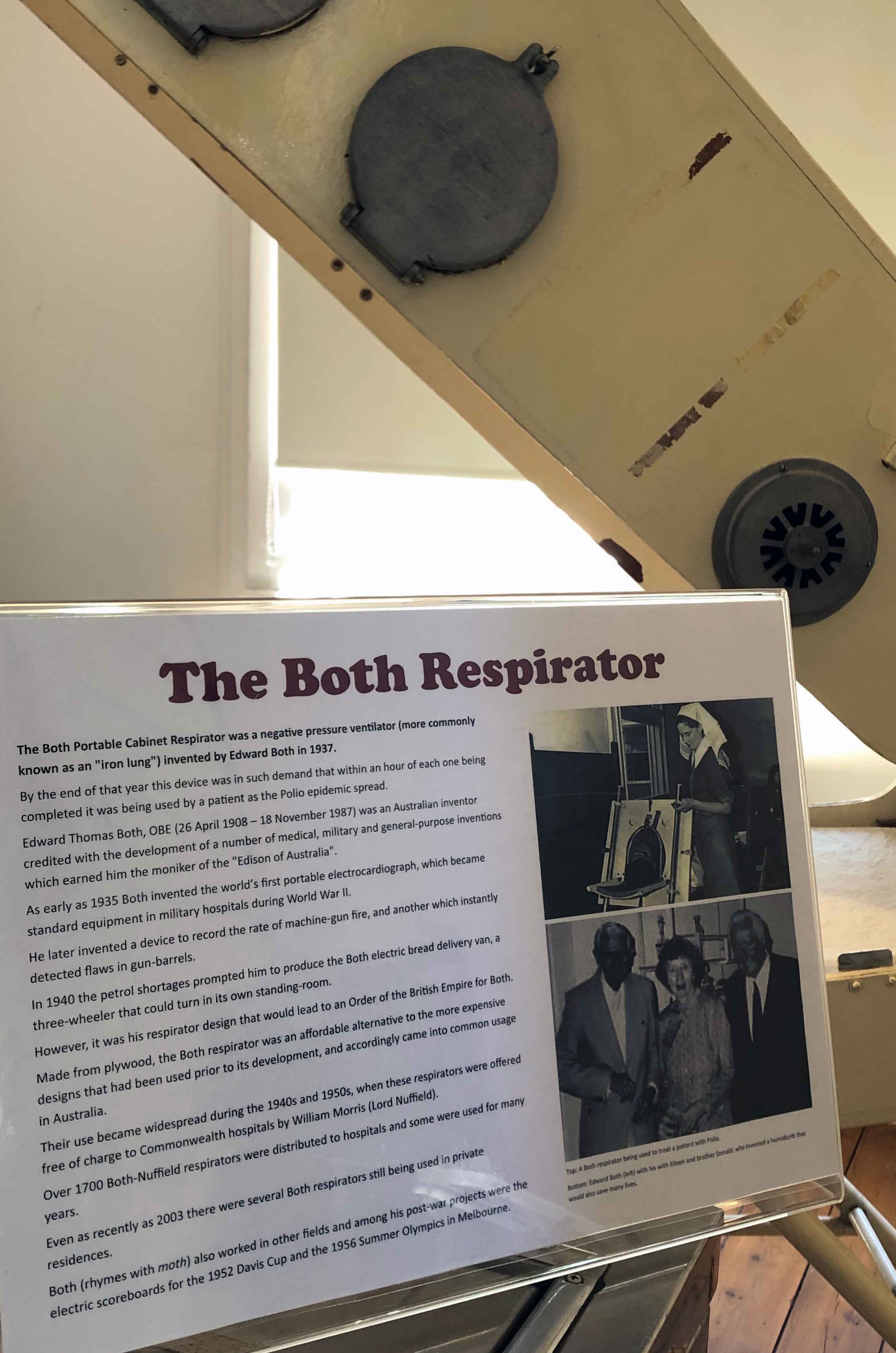
One of my first activities was to create this interpretive panel for their iron lung.
It surprised me as I'd already written about this item when I worked here six years ago, but returning to it I learned this is a Both respirator.
Edward Both was an inventor considered the "Edison of Australia" and he had a remarkable career in medical and military settings, as well as creating a scoreboard for the Melbourne Olympics.
This week I shared with a Studio Co!Lab what I've learned using the Cut-Up Technique
To begin my talk I encouraged everyone to print a copy of Picasso's poem about noon, since he's known to have stated that artists steal and it feels right to honour this contemporary of Cut-ups.
My Cut-up experiences have been realised in lyrics, sampling and also a book that invites destruction.
I also mentioned the poetry reading that I gave at a book launch which performed a live remix.
We began cutting Picasso's poem into individual words while I explained how the imagery reminded me of the Riverina and introduced David Bowie's use of the technique.
The singer acknowledged his debt to Brion Gysin and echoed some of the magical attributes he promoted with a process pioneered earlier in the 20th Century by Tristan Tzara.
My recollection is Cut-ups were a significant development in the split between Surrealism and Dada, when Tzara created a "manifesto" using newspaper clippings.
At the time the Surrealists were writing manifestoes and took offence at this brute process for generating words.
However, the cut-ups have been seen to share in common the influence of Freud's ideas of dream analysis as a way of identifying cues from the unconscious.
Cut-up documents interrogate the text in a haphazard manner that reveals as much about the dynamics and relationships of the reader, while allowing anyone to be an author.
In this way it shows a Dadaist antiestablishment attitude that can be seen as an attack on authorial intention.
Some might view the process as reassembling a document and the process can be viewed through a variety of philosophical positions, such as the magic and art roles.
When you begin creating a cut-up text there are decisions about the process that determine roles for chance or probability.
You might choose to draw a word from a hat, or you might assemble them from a visible pool of possible words.
My partner developed an exhibition that referenced William S. Burroughs' use of the Cut-up Technique in 2014 and that year introduced me to an alternate approach proposed by the Disquiet Junto.
While the process of preparing the pieces and then pasting them together has a meditative quality that suits gallery spaces that are open for more of a performance art aesthetic, the simplicity of the idea is ripe for technology.
It is interesting to see David Bowie returned to the idea as personal computing developed with the Verbasizer, which has been beautifully realised at this website.
The idea of cutting seems simple and it's worth remembering that many ideas about editing have developed since Tzara.
When you cut up a text the words are never entirely anonymous, even if the document become a palette for beige language.
Each discrete piece becomes a springboard for a chain of connotations, which is a process that has been called "unlimited semiosis" in semiotic theory.
These become potent symbols and through the popularisation by Gysin the cut-up practice came to be infused with ideas of magic that were researched by Genesis P-Orridge.
Burroughs undertook audio and film-based cut-ups that extended the ideas he identified in literary practice.
I explained an audio-based curse that P-Orridge detailed and how sampling harnesses a similar energy when it takes a small example from a larger whole.
Working with the landscape as a document to sample you find inspiration in selecting small symbolic examples to trigger memories of entire ecosystems.
Which l led into my discussion of my Soundscaping videos and exhibitions.
Using video as a medium for cut-ups led to the role of Arthur Lipsett's 21-87 in the development of Star Wars.
I pondered religious implications as well as broader philosophical questions of free will and determinism.
There were some questions towards the end, including some discussion of AI and machine-learning tools.
I talked about my collaborative poetry, where I fed lines about the environment into a website.
It offered results that were surprising in a way similar to cut-ups but overcame a key constraint.
The responses from AI saw angels, which was delightful and language that I never use.
So the AI experiment gave a nice counterpoint to the Cut-up Technique and Andrew, the moderator, decided that was the moment to end.
Along with the children I knew at one primary school, we all specialised in various forms of torture
One of the most common forms was vividly describing pain and letting the victim stew in their own tense juices.
At the time it was popular to give exotic names to the different styles of torture.
Jungle Torture, for example, involved inflicting a sequences of techniques that would ascend in their intensity.
This would begin with a series of tickling finger-flicks across the chest while describing ants, then progress to pummelling as elephants negotiate the terrain of the victims torso.
Some of the most severe actions came from Asian countries, such as the wrist burn attributed to the Japanese.
It would involve the torturer grabbing a wrist with both hands, then twisting in opposing directions.
My skin was supple back then and I don't recall it caused more than a brief rash, but now I wonder if my dry wrist might catch and rip open on that bony bit that protrudes.
However, there's something about anticipating the touch of my torturer that also feels different now.
I hold hands so rarely with anyone now my kids have grown up -- and not because I scared them away with wrist burns!
My body feels a bit tingly just thinking about someone grabbing me.
Another approach might be Chinese Water Torture, which uses dripping water to slowly frustrate then irritate then madden a victim.
Thinking about this while I lay in the bath recently hearing the shower head drip, I realised it seems underwhelming.
I expect the sound of dripping would barely register among the hum of daily life or even my tinnitus.
The tortures I knew as a child all seem out of date.
Now there's something appealing about the idea of being touched or having enough silence to find dripping water sound loud.
And, of course, the real tortures of waterboarding, electro-shocks or locking-up refugees on remote islands has been well-documented.
There seems to be a lot of backward-looking music these days
Triple J, Australia's youth radio station, had their Hottest One Hundred on the weekend and, while we were listening my brother observed how many more tracks this year were covers or remixes.
I told him how my new favourite critic had a similar observation of Tiktok's trend for earworms made from snippets of nostalgic tunes.
Ted Gioia has written that younger audiences find it comforting to hear the same songs, as well as bemoaning the limit this places on music discovery.
It prompted me to reflect on those pop songs that I'd hated hearing until, after memorable moments on dancefloors, they became triggers that allowed me to re-experience ecstasies.
So I'm now experimenting with making memories.
On the weekend I tested the role of music in becoming a soundtrack for moments (or making moments from soundtracks?) when I drove my son from home.
He's moved to the city to start uni and we packed stuff into his car and drove for hours to a much larger town.
As we were leaving I thought to grab a CD for the drive and reached for my favourite purchase of 2022, The Avalanches' latest album.
While I've been a longtime fan of the group, I didn't immediately jumped on their last couple of albums.
It wasn't until 'Red Lights' popped up in the credits of a TV show that I remembered I was going to give them a listen, then it was a pleasure to hear their return to form.
Given the gap between albums for The Avalanches (and the diversity they like to show while playing live), I'd had doubts whether they would still meet my expectations.
It's great to find things where you left them!
So, anyway, my son and I were driving from home and the mood was tender.
Rather than listening to the radio, where you run the risk of news headlines, I thought music would be better for reflection.
The album "We Will Always Love You" is kind of a twist on the theme of The Avalanches first album, "Since I Left You" in being about distances.
Where the original trumpeted the joys of travel, this return-to-form is about missing people.
While we listened to it, I think we got to the third song, when my son asked "Did you have to pick an album about leaving?"
I told him that this is how memories are made and that I wanted to remember this trip with one of my newest favourite albums.
I recounted the ripple-down-my-spine that would accompany listening to The Bird after I saw them live, or how the songs I thought were drivel would weirdly become irresistable gems on certain dancefloors.
Then, as we passed a harvested field of stalks with red dirt showing through, a dust devil spun toward the road and I remembered how my Wiradjuri friends would say those show when spirits are visiting.
I'd heard that at a farewell for a friend and now began to wonder if she weren't giving us a wave on our journey, then the tears sprouted from the corners of my eyes.
We listened to the beautiful music.
Anyway, when it came time for me to leave my son and return home, I left the CD with him.
I hope he'll put it on while watching a sunset and know that we're seeing the same sight.
In the meantime, I can tweak the raw nerve of his absence by listening too.
One more bit of The Avalanches theme of our weekend, while my son and I were indulging in our shared love of shopping at secondhand stores, we found a copy of Koichi Oki's "Yamaha Superstar" for six dollars.
He enjoyed it, but that shouldn't be a surprise since it's all covers!
My daughter likes Christian Bale in American Psycho and Mads Mikkelsen in Hannibal


Of all the possible things that I couldn't have predicted would happen in 30 years, that I'd be watching a film adaptation with my family and seeing my daughter dress as Patrick Bateman for halloween really shows how little time travel I've taken.
Here I am performing poetry “with an avant garde twist”

I recorded this version of the piece the following day:
Photo by Neil McAliece.

Recently I recorded my partner singing the songs she'd sing to put our children to sleep
I'd first considered this when those kids were much younger and, since they don't need to be sung to sleep, it almost seems redundant to record those lullabies now.
Most nights they wish me goodnight hours before they plan to go to bed!
However, it had been one of those activities on my to-do list, then the Disquiet Junto prompt last week reminded me.
The reason is one that Thomas Edison recognised when he developed the phonograph:
The family record; preserving the sayings, the voices, and the last words of the dying members of the family...
Earlier this year a friend died from Motor Neurone Disease, which was confronting for the speed that it took away her abilities.
After the friend lost her ability to speak, my partner found a recording she'd made of her singing.
It was powerful to hear her voice again and a reminder of the importance of capturing those moments.
The inFrequency tour rumbled through Yanco on Saturday night as a diverse line-up brought their audiovisual performances to town


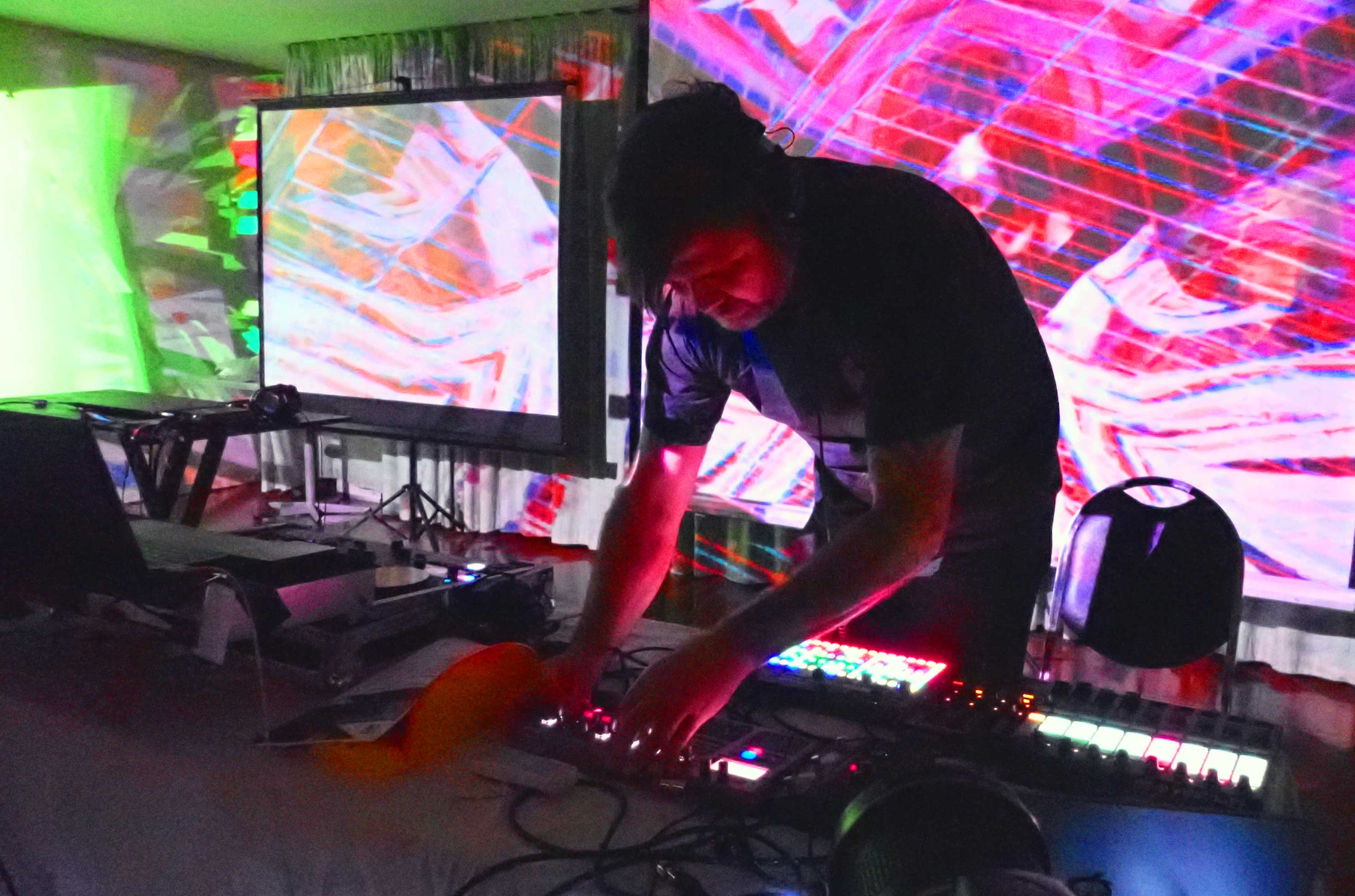


The All Services Club provided a warm and friendly venue, as well as being enthusiastic in their support for the event.
Thanks also to our bartender, Dale.
The inFREQUENCY tour will bring together electronic musicians from the southeast and southwest for performances and workshops that showcase their different approaches

“Our aim is to create opportunities to share cutting-edge audio-visual art through live shows and workshops that will provide a behind-the-scenes perspective on the techniques being used.”
There will be demonstrations of video projection-mapping and live-coding that provide an introduction to free software in workshops before the performances dazzle and inspire audiences.
Artists Scott Baker and Jason Richardson have two decades of experience in working together, including running projection-mapping workshops at Griffith Pioneer Park Museum in 2016.
Both were part of the Unsound Festivals that ran in Wagga Wagga, which put Australia’s experimental musicians on the world stage.
Baker has developed audio-visual art as Abre Ojos and his new techno persona Dron Skot, while Richardson’s work as Bassling has also gained national and international interest.
“This project began when I was enthusing to Scott how Bernard Gray was developing live-coding performance skills in Griffith with the DECODED workshops” says Jason.
“It brought to mind the skills in music-making and video-editing that I’d learned in Wagga, so we began planning a way to bring together this diverse group of musicians based in regional NSW.”
“Scott identified artists Myst Mach and The DJ Ruined My Wedding Day from the South Coast and we thought it’d be great to create performance opportunities to develop skills for the musicians and the audiences, because you never know where the ideas and experiences can take you.”
Myst Mach is a young producer and DJ from Tathra who pulls together genres far and wide to mould them into a kinetic object in their own dancefloor-focused journeys.
The DJ Ruined My Wedding Day will make you as giddy as a bride on their wedding day and build you up to only take you higher with their DJ set colliding old favourites with the best underground tunes.
Baker and Richardson reflect how the skills they’ve developed came from experiments with technology, performance and exhibition.
“It’s great to get out and perform, but it’s even better to aim to inspire the next generation of regional artists through the workshops we are running,” says Jason.
Tickets are available via https://www.infrequency.au/
The inFREQUENCY tour is supported by the Backroads Initiative and South East Arts through funding from Create NSW and the NSW Government.
I'm certain they mean "route" rather than "root"


I remember seeing the film in the cinema while in high school and enthusing about it to my friends.
Then, when it came out on video, I was unable to watch it again for years as it'd been reclassified as R-rated!
Unlike the R-rating shown in the US advert here, Australia's R is restricted to anyone under 18.
Anyway, I showed the film to my kids last year since they are all in high school.
It stands up well, despite the decades and development of various technologies -- including police robots.

Red Earth Ecology is looking to commission four local artists for the "Leeton Memories" project, which will transform reminisces of older residents into shop front displays

"We have a small budget to cover materials and contribute something toward the time of the four contributors."
Edited extracts from recorded interviews with longtime residents will prompt and inform a series of shop front installations and be linked to these displays using QR codes.
"The idea is that you'll be able to hear a recorded commentary from older residents and that will inform the experience for viewers seeing the artworks," says Jason.
"We hope people will think broadly about what materials can go into making a display and the budget should help to realise their ideas."

Each display will be promoted with a profile of the contributors and discussion about the themes raised in the interview.
"We will also share our CASP application for this project with the artists, so they can get an understanding of what goes into a successful funding proposal."
Afterwards Red Earth Ecology will consider assisting with grant applications from the artists for the development of future projects in our region where they relate to the aims of that organisation.
"Red Earth Ecology was incorporated to enable projects that link people to the landscape, whether through plant regeneration activities or cultural practices like making artworks," says Jason.
"There's also a need for pathways in the Riverina so artists can develop local projects and we're willing to provide guidance."
"We want this Leeton Memories project to be the start of something that will create new memories in Leeton for years to come."
Leeton Memories is supported by Western Riverina Arts and Create NSW through funding from the NSW Government.
Youtube's automation of copyright claims should be questioned

A recording of my drumming, in fact two recordings of my drumming layered together, has been monetised by a company claiming I'm infringing on their copyright.
Someone else is collecting ad revenue from my material based on an automated response!
Youtube is facilitating this spurious claim and I think their system needs to be scrutinised.
While there's definitely space for professional artists, I think art should be for amateurs
If reading Julia Cameron's book The Artist's Way taught me one thing, it's that creativity is our human birthright.
There are almost as many ways to make art as there are to be creative and creativity is where innovation happens.
Yet I see my kids increasingly losing interest in learning to make art, partly because the model of education is based on emulating the teacher.
We need to foster creative expression in our communities since it seems as though their individual differences are disappearing as the world shrinks.
I believe everyone should have an expressive habit or two.
These outlets reflect individual experiences by channeling passing thoughts and dreams while refining techniques -- maybe even inventing new ones.
The problem with making a thing professional is that one ends up becoming a manager.
This is something I learned at university, even without studying management.
When I worked there it was kinda bizarre to observe that academics would move into management roles.
These were people whose passion had led them to specialise in fields that became increasingly obscure as they got more qualified.
There was a tension between managing students while achieving research outcomes.
Yet all the time they were researching their expertise, the university would dangle jobs in management.
Career progression for many probably stalled with the casualisation of the workforce (driven by management consultants), so the only job security that seemed available was moving into something managing the casual staff.
I feel like I've seen the same phenomena in the arts world, as one-time artists become administrators and consultants.
It makes sense as one has to learn to justify the passion to create by developing a business case to apply for grants and navigate processes like running a board, buying insurance, marketing creative outcomes, etc.
The drawback is it becomes isolating as artists share less of their inspiration, which is the stuff that makes their creative output meaningful to audiences.
As an audience I don't want to be told something is important, I want to know why it's important to the artist.
Human interest stories are engaging and the best teachers make it feel as though you're on the journey with them, discovering the outcomes as they explain their development.
In some ways it seems a similar outcome to the academics who no longer teach their specialisations, since it's the process that reveals the intricacies of a subject to an increasingly educated population.
However, the qualifications in our communities are now increasingly administrative ones.
As a result, we see the justification for creative practices framed in terms of economic values.
Maybe the move toward government budgets recognising well-being will see a new framing for the arts?

Part of me regrets putting smoke into the local environment and burning logs that have the potential to be habitat.
Another part recognises the awe that stirred my ancestors as I look into the flames and let their flickering light guide my thoughts.
My family know I'm strict about when we'll have a fire and the general rule is the forecast maximum needs to be less than 14C or the minimum less than 4C.
This River Red Gum outside Bingara looks like it could walk around

Unfortunately the scale of the tree isn't apparent in the photograph, but I could've climbed through the space underneath this amazing tree.
The end of semester means reading reports about the education of my children
Usually I only pay attention to the comments and look to get a sense of how much effort their putting into subjects.
Then I'll ask my kids how they feel about the report and usually they agree.

It raises some questions, since one section details how they're learning more than a year's worth of math but acknowledges the measurement isn't indicative because the difficulty of modules varies.
I pity the kids with reports saying they're learning less than a year because who knows what discipline might be delivered in the privacy of households.

Winter sucks, right?
Anyway, I like the new reports but wonder if other subjects can do something similar.
If math can provide numerical detail, maybe English can start spicing up their comments with exotic superlatives and hyperbolic verbosity?
My grandfather had a collection of paintings on his walls
When I was a child I was curious about the art produced by my uncle, but otherwise I never thought about the rest until after he died.
Then the paintings were divided among his children and my father started having paintings on his walls.
I thought it was cool that one was by Pro Hart, since I'd heard of him.

(I'm not sure who it's by, sorry I know that I should have an acknowledgment.)
So it might've been because I like riding bikes, but I hadn't really liked the painting.
I think I might've thought that the wavy lines seemed to ruin the image.
The result seemed a bit vague and indistinct, but now that's one of the things I like about it.
It's kinda dreamy and dynamic.

That was one of those lightbulb moments, when I realised how the process of painting contributed to the resulting image.
It reminded me of how colour photography works with layers to produce a representation.
Yet, rather than a chemical process, I could see how the brushstrokes built up the image.
Since then I've learned about blocking, the colour undercoat that sets a tone for a painting.
Now, when I see the painting of the cyclist, I surprise myself with new details that I admire.
The wavy lines capture movement, both in their representation and in their physical process.
Lately I've been appreciating the colour palette, particularly the light blue and lime green and brown.
Last week the high school called to say my son was getting an award

On Friday my partner and I went to see the presentation during the school assembly.
We checked in at the front office, received our visitor passes and were led to the auditorium.
I scanned around to see if I could spot my sons and found my youngest sitting at the front of the room.
They began reeling off details of my oldest son's contributions to the school.
It was interesting to hear them describe him as an "all-rounder" since his interest in sport is limited.
There were performances with the choir and school musicals, representing students on the SRC as well as debating and chess competitions.
They noted his subjects included extension English, advanced maths, chemistry and music.
Then his name was called and there was a rapturous applause.
Afterwards the teacher asked if it had been a surprise.
Oscar said his friend had spotted Jo and I, asking him why his parents were here, which had led him to assume that he was getting the award.
The platinum jacket will appeal to him, since he's been wearing the shirt given in Year 10 almost everyday.
It's good to see Oscar's efforts recognised.
Woke from a dream in which I'd written a profile of Russell Crowe for Rolling Stone
There was a formatting issue and they needed me to resend the piece and I couldn't find it.
I was living with Taika Waititi and came home to go through my laptop, only to find he had friends over.
They were watching TV loudly and I needed quiet to look through my files in a panic.
Embarrassingly I started yelling at everyone.
Taika kept his cool, but his friends began chastising me.
I think my subconscious is telling me not to apply for the feature-writing mentorship that I saw yesterday.
Naviar Records have chosen one of my senryu for their musical prompt this week

It's been a good week for senryu, with news that another poem has been selected for a journal.
Got to see (and hear) my contributions to the Inhalare exhibition developed by Kim V. Goldsmith

At the event last weekend we discussed how to progress the exhibition.
This brick wall in Jerilderie caught my interest

The building overlooked the Billabong Creek, which runs through town.
I mentioned it to a local, who explained their husband had memories of walking along planks to reach the nearby primary school.


