


Greg is a multi-disciplinary artist who features in the exhibition Ngurambang (Our Riverina) at Griffith Regional Art Gallery from 1 July to 20 August 2023.
This video was supported by Western Riverina Arts and Create NSW through funding from the NSW Government.
Kerri Weymouth discusses her contribution to the Ngurambang (Our Riverina) exhibition at Griffith Regional Art Gallery from 1 July to 20 August 2023.
This video was supported by Western Riverina Arts and Create NSW through funding from the NSW Government.
One of the questions the film Oppenheimer avoids is whether it was a war crime for the US to drop atomic bombs on domestic targets

I've been reflecting on that question during the anniversary of that watershed moment.
One of the most profound spiritual experiences during my visits to the Quaker Meeting House in Canberra was when an American woman felt moved to speak about the bombings.
She was in tears as she announced her feeling of guilt for being from that country.
It would've been about 30 years ago now and in my memory it is when I recognised how the spirit moves one to testify in that setting.
That day was tempered with an observation by the late Hector Kinloch, who stood in meeting to ask if anyone had seen the beautiful rainbow that appeared during the week.
Increasingly I find a spiritual gap in my life and wonder whether I should return to prayer with the Quakers.
This detail from Christopher Orchard’s ‘Mirrul’ artworks has been on my mind, specifically the removal of front teeth

This led me to wonder whether intiation for Wiradjuri men was accompanied with a lesson about not being greedy and to think of others when you hunt.
I recognise that knowledge is not my culture to know or share, but I feel like that lesson would be a good one in a world with limited resources.
Orchard's artwork is currently exhibiting as part of the Ngurambang (Our Riverina) show at Griffith Regional Art Gallery until Sunday 20 August, when there'll be artist talks after 11am.
Christopher Haworth is a plein-air painter from Talimba who features in the exhibition Ngurambang (Our Riverina) at Griffith Regional Art Gallery.
This video was supported by Western Riverina Arts and Create NSW through funding from the NSW Government.


However, the anniversary is an interesting coincidence as recently I've been reflecting on the Fragments exhibtion that Hape curated as I've been focused on researching Murray Cod.
It's a long story, so let me try and make sense of it.
The fragments that formed the exhibition were offcuts from a River Red Gum that Hape Kiddle sculpted into a Murray Cod for the National Museum of Australia.
He offered big chunks of timber to local artists and asked them to use these for the exhibition, while he worked on the sculpture.
Last weekend I ended up at the Museum and went looking for Hape's Cod.

My current interest in Murray Cod flows from an even bigger sculpture which resides in the museum where I work.
"Gugabul" was offered by Pete Ingram to be part of the Ngurambang exhibition that I curated for Griffith Regional Art Gallery, until we realised it wouldn't fit through the door.
Pete had built the massive Murray Cod sculpture for the Hands On Weavers and it was exhibited in Wagga's art gallery last year.

In recent years this vulnerable fish has become a premium aquaculture product and, depending on my route, I can pass a couple of hatcheries on the drive between home and work.
So I've been researching Murray Cod and they are fascinating.
Like Emu, they're another Australian icon where the father protects and raises their offspring.
These fish are an apex predator in rivers throughout the Murray-Darling Basin.
The Murray Cod plays a role in the creation of those rivers for many First Nations and the best documented example describes the Murray River, in a story that is told along much of its length.
With help from family Ngurunderi finally caught Ponde in Lake Alexandria, where the fish was cut up and the pieces thrown into the water.
These fragments of cod became the other species of native fish, until the head remained and it was thrown back to continue being Ponde.
So after five years I have a greater appreciation for Hape's exhibition and the way he interpreted the Dreamtime story of the Murray Cod, by sharing fragments of his arts practice to inspire other artists.
There's always a variety of meanings to take from Dreamtime narratives and it's significant that Ngurunderi needs assistance from his family to capture Ponde, as well as his recognition that you can't eat all the fish.
My brother has a pair of Sansui speakers in his living room


I walked into a training session yesterday and overheard someone say "he looks like a curator"
One of the best things about returning to work at the Museum has been the feeling that this is where I should be working.

Different councils do things differently, but the fact that I've done multiple training sessions and only just got past my employee probation is one sign of an organisation that invests in their staff.
One sneaky thing they did was to give me gifts when I completed that three-month probation.
I can recognise that unsolicited gifts generate goodwill, which is something council normally remind staff about for the risk of corruption.
The fact they are trying to use this technique in a way that produces a psychologically-demonstrated effect in employee behaviour is something that I can admire and revile in equal measure.
That's equal opportunity for you!
This is one of those Saturn Returns stories and begins with a dream in 2016
I had begun work as a curator and fell into a swine flu fever.
There was one sleep where I was walking among River Red Gums and saw human-shaped scars on the trunks, then realised people had gone through these doorways.

We spoke about the theme of relationships to the Riverina and she sent a letter of support.
When I told her about my dream, she laughed and said "You've been visiting my world."
It was thrilling to see her painting hanging in the Ngurambang exhibition and I hope it's the first thing you'll see when you enter the Gallery, from Wednesdays to Sundays until 20 August.
My museum has landed a whopping great big new exhibition!
Murray Cod are one of the largest freshwater fish in the world and an apex predator in the waterways where they live.

Their sculpture is accompanied with a colourful animation produced by Aunty Lorraine Tye that shows a Dreamtime legend from along the Murray and Murrumbidgee rivers.
This exhibition shares a variety of perspectives on Murray Cod, as well as discussing First Nations and European fishing practices.
You can also read observations from John Oxley, Charles Sturt and Mary Gilmore, as well as learning why these fish make great fathers.
In recent years Murray Cod have become a premium aquaculture product that’s grown in our region and one that has developed from the research of John Lake, who the Narrandera Fisheries Centre is named after.
Come and meet Gugabul in the Irrigation Museum building at Griffith Pioneer Park Museum.
Griffith Regional Art Gallery will host artist Jo Roberts during the Ngurambang exhibition, who will offer a school holiday activity during the opening weeks


Can I waste your time?

I have a couple of contributions to share.
The Ngurambang: Our Riverina exhibition aims to give viewers new perspectives on the landscape and to demonstrate some of the diversity of talent from creative practitioners working across the region
Griffith Regional Art Gallery worked with curator Jason Richardson to gather a group of artists from across the region for the current display.
"Viewers will find familiar scenes and they will also be challenged to recognise others.
"One of the greatest benefits in experiencing art is looking through another's eyes and this exhibition asked the artists to share their observations about an environment we all share.
The result offers insights into the diversity of creative practice across the Riverina while reflecting on individual interests in the landscape.
"The idea that art can help audiences build connections with the environment has been developing since I worked with Landcare and it's something I've explored through previous exhibitions, our not-for-profit Red Earth Ecology and also recorded interviews with artists and places," said Mr Richardson.

The other week I had a feeling that I should take a photo of myself
It seemed a weird urge at the time, then I noticed a couple of selfies in my Facebook Memories.
When I mentioned this to my partner, she observed that this must be the time of the year that I feel unseen.
That interpretation didn't sit easily with me, but then I noticed increasing numbers of self-portraits in my Memories.
And then I began pondering the stuff my friends are posting.

The final instalment in Red Earth Ecology's Leeton Memories project brings together two prominent local women

"My interests now include designing for theatre so I'm treating the display as a small set," said Mrs Arel.
"A lot of what I've included are scenes from nature and the social aspects that unite people.
"I made notes and focused on her early childhood, particularly the red dirt and when she talked about Parkview, like climbing trees in the scrubby setting prior to the School being built."
Viewers will be able to listen to Julie's memories via audio-streaming linked in the QR code shown in the window of the Leeton Community Op Shop.
"I thought I'd be working on it earlier this year, but I'm glad this exhibition came after a history unit that I recently completed.
"Memory is not exactly how it happened, so I'm layering old and new. I find it interesting to think how memory works, the way things that mightn't have been a great experience become lessons of resilience over time.
"Originally my intention was to use chronological layers, but that's not how memory works. Every time you revisit that memory, it changes a bit."
The interview with Julie was conducted by Kathy Tenison of Storymaster Audio and collected details from throughout her life, including the Carlton Cafe that was next door to the current display and significant as the location where she met Paul Maytom.
The Leeton Memories project was developed by Red Earth Ecology as a way of bringing colour to windows on the main street and to prompt discussion of change.
"We're stoked that Cynthia joined in and are very grateful to the team at the Op Shop for the chance to use their location and its visibility within town," said Jason Richardson.
"This project has been a wonderful way to get to know people, as well as share some history of the region.
There's been a lot of support but I am particularly grateful for our host, the Leeton Community Op Shop, and great response from the community too."
One surprise was learning that the artist and subject already have a connection.
"Julie and I are actually related," revealed Mrs Arel. "Her dad and my grandmother were cousins and she went to school with my aunty, so the places she talks about are those I've heard about or visited.
The reframing of the familiar in new ways has always been central to the appeal of looking at art, which can also build empathy by letting viewers see through the eyes of another.
"It's an opportunity to think about things from a different angle and to view things from a perspective other than my own, " agreed Mrs Arel.
The project is also a platform to demonstrate a spectrum of creative activity in the Shire.
"It's important to present the variety of art as a way of showing what can be done, especially for younger people. People will say what they like or not, but it's helpful to broaden their view."
Leeton Memories is supported by Western Riverina Arts and Create NSW through funding from the NSW Government.
One of the fun things about working in a museum is exploring storage areas

Last year I joined a project writing about regional museums
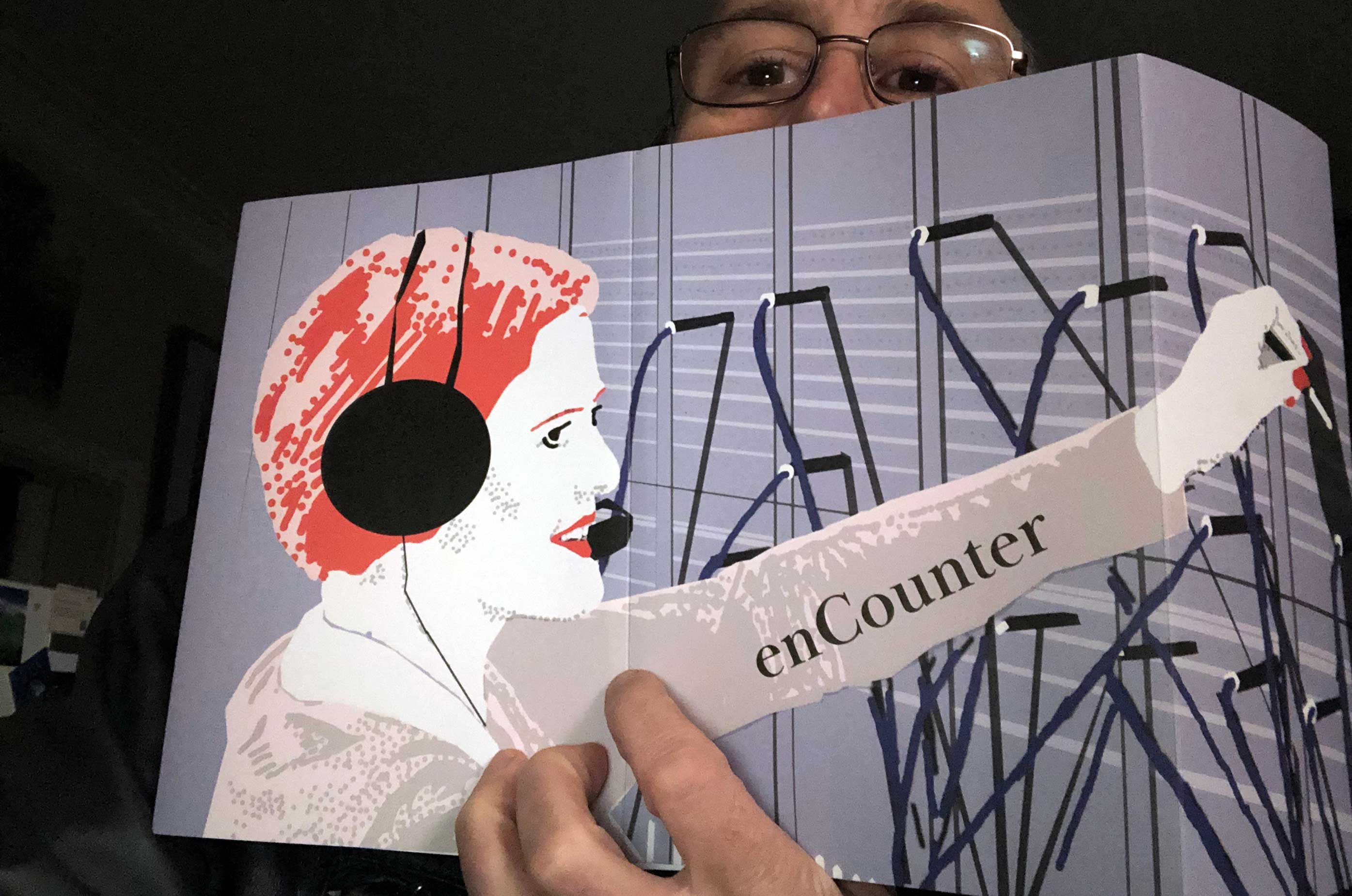
Orana Arts ran this project and the mentorship was stimulating, then they asked if I'd design a cover.
I thought the image of a telephone switchboard worked as a metaphor for the connections being formed.


Even more excited to discover one of my Junto videos was part of an exhibition in France!

One theme has been sovreignty and seems to me this will be one of the first topics the Voice will discuss and it's clear the referendum does not diminish that issue in promoting a treaty being established with Australia's First Nations:
"All members of the Expert Group agreed that the draft provision would not affect the sovereignty of any group or body."
Today I had an "open" studio for the Art Trail around Leeton Shire
I'd installed my Organ Donor sound sculptures in the front yard and could overhear a few comments from people passing on the street.
It was a last minute decision to set up a studio, since I wasn't sure I'd have any visitors.
A couple of people came to have a look and I amused myself by recording this cover of Nirvana.


I like the drop-shadow on the older text.
The next installment of Red Earth Ecology's Leeton Memories project is in the windows of the Leeton Community Op Shop this month

In the accompanying audio Peter and Jenny Randall discuss their organic rice business with Kath Tenison, while the display discusses the effectiveness of this approach to farming.
"Biodiversity has been a significant environmental consideration in recent decades," says Mr Richardson, featured artist and project coordinator.
"However, I suspect it's one of those buzzwords that might not mean much to many people and the Randall's have beaut examples that demonstrate how it can contribute to our lives."
In the interview Peter outlines how the diversity of organisms in his rice fields assist with the growth of crops, while acknowledging the health risks that chemical inputs pose to farmers and our Riverina generally.
"Mr Randall has seen the impacts that poisons have had on farmers and I think his observations offer an important lesson, as many land managers are currently struggling with the concerns about glycophosphates for example."
The display designed by Jason illustrates how an 'environmentally-friendlier' rice crop can promote biodiversity, showing impacts such as microscopic organisms through to waterbirds like the Australiasian Bittern -- which has become a focus of conservation efforts.
"One of the themes being explored in this project is environmental change and the interviews reflect observations from local people in their own lifetimes," said Mr Richardson.
"This project developed from conversations we've had and a desire to help people understand their environment, in part because it's curious to see discussions like these often fail to acknowledge people are part of the landscape."
Text-based contributions have come from the Leeton Writers Collective, following a listening event to hear memories from the project.
Jo Roberts incorporated a poem written in response to Joe Errey's story about the packed trains arriving outside town during the Depression.
"It's great to share one of the poems from Sarah Tiffen's last book alongside the Randall installation," said Jason Richardson. "I admire her writing and like how that piece explores connections with places."
"Riverina,Writing House and Leeton Writers Collective have been so pleased to be part of this project," wrote Ms Tiffen.
"Telling stories in different ways is essential to belonging and identity. Red Earth Ecology's ethos of environment, place and honouring of our place within Nature is an important part of our community story."
The Leeton Memories display concludes a busy month of projects for Jason Richardson, including the launch of The Penny Effect video at LMAG, winning "Champion Exhibit" in the annual Art Society exhibiton and a program of events at Burning Seed in Matong State Forest.
"Red Earth Ecology held a series of talks and workshops on the applications for funghi at Seed this year, and I also installed over 100 wind organs as part of a display to raise-awareness about organ donation."
Those wind organs will next be seen as part of an open studio event organised by the Leeton Art Society and Narrandera's arts and craft network that Jason Richardson is joining during May.
Visit Leeton Community Op Shop to see the Leeton Memories displays and hear the interviews.
Leeton Memories is supported by Western Riverina Arts and Create NSW through funding from the NSW Government.

Groups of children can display a full range of emotions in these situations.

One of the best things about working at the Museum is the people
There are so many passionate individuals who have contributed to the Park. You can scarcely look around without noticing a human touch, from the wear and tear to the gardens and plaques.
Many of the people who visit have their own connections or remember family members who were involved. This is what makes Action Day so special, as there are volunteers who appear and suddenly an old engine is running.
On Good Friday I observed one of those moments.
It was nearly time for the gates to open and a car was loitering near the Tractor Shed. I checked they knew and was told by the driver that he'd park at the top again.
Then a woman indicated an older man in the front seat and told me they had brought him to see the T-20 tractor. I don't know much about tractors but the T-20 is distinctive for its caterpillar tracks and I know the Museum has three of them.
Continuing to talk about the older man, she said something like "we haven't seen him smile for months and thought he'd like to see the tractor he restored."

I recognised the opportunity and started filming the tractor roll past, then panned toward the older man as he sat in his wheelchair. It wasn't clear if he was smiling, so I walked forward.
"How does the engine sound?" I asked.
His voice was a mumble among the engines that were running, but he seemed pleased.
By now the bloke who'd been driving both the car earlier and now the T-20 had parked the tractor and walked over. He explained the older man was born in 1935, the same year the tractor was released.
Joined a life drawing class led by Anthea da Silva yesterday

Anthea's guidance often aimed to unsettle established practices and prompted me to reflect on how art benefits from creating possibility, rather than settling into a rut.

However, while the result isn't something I want to share here, it was surprising to me.
I could see a different artist in my work and an entirely new style that was waiting to be explored.


This photograph of a culturally-scarred tree I called 'Summer Equinox' as the theme for the acquisitive award was seasonal and late summer is when trees will give up their bark.
The printing onto pine was an opportunity to raise awareness about the impact of pine plantations in the Murrumbidgee Valley, since critics have said these take 110% of rainfall as they'll draw groundwater from neighbouring properties.
My entry was declared "Champion Exhibit" and it's led to my family calling me "champ"!
Penny Paniz made art by many names and was central to the creation of the Leeton Art Society and Western Riverina Arts.
A couple of years ago I was commissioned to produce this portrait of her to accompany the exhibition held annually in Penny's name.
After delays it's now a permanent feature at the Leeton Museum and Gallery.
Last weekend was Burning Seed, the NSW Burning Man event, and I got a small grant to build a collection of over 100 wind organs.

Griffith Pioneer Park Museum is seeking out those who remember the old Post Office in Griffith, as part of their new display
The Post Office was on the site of the current building, but an older style with red brick and grand arched windows.
Pioneer Park Museum has a recreation of the original Griffith Post Office which was operational from 1925 to 1979 with staff keen to talk to those who have stories to tell about the original building.

“Do you have memories of the Griffith Post Office? Maybe you received an important telegram, or worked behind the counter? We would love for you to share any stories you might have.”
Postal services at that time included technologies not seen today, like telegraph operators communicating through the percussive messaging of Morse Code. Aside from parcels and letters, the building also housed the switchboards used to link telephones in the region.
“Those who lived on farms might remember the distinctive ringing of their party line, which indicated when a phone call was for their household rather than another that shared the connection,” said Mr Richardson.
There are many ways the Post Office connected Griffith and it’s surprising to discover what services were provided in the building.
“Phyllis Bell recently recalled working as Phonogram Operator for seven years and says her colleagues were the nicest people,” he said.
“She remembered that as she progressed to being a senior staff member, her role included liaising with the CSIRO to update weather reports placed at the front of the Post Office.”
Memories like these will help the new display to reflect how important services within the community have changed.
“It’s details like these memories that help Pioneer Park Museum to share the experiences of the local people who shaped our history,” said Mr. Richardson.
If you have a recollection of the Griffith Post Office, please contact Pioneer Park Museum.
A visually-arresting and innovative approach to local history will debut in Leeton this March

This is the first of a series of window displays that, over coming months, will interpret observations from elders about their lives in our town and bring into focus changes in the local landscape.
"This project began with a conversation I had with Joe Errey," said Jo Roberts.
"We're both keen observers of birds and I was enthralled by his descriptions of flocks of birds, particularly those that are now rarer to see over our town."

This towering giant sits a little way off Vance Road and marks the beginning of the Errey family's connection to Leeton after they settled on the land.
"I was also amazed to learn that Joe's pet corella is more than 50 years old, which seems mind-blowing when you consider how common these birds are in our region," said Ms Roberts.
The bird, named Sam, can often be heard calling out to those passing by Joe's home on Brady Way.
The Leeton Memories project has collaborated with Kathy Tenison of Storymaster Audio to record interviews that capture local history from the perspectives of older residents, then Red Earth Ecology offered these conversations to local artists for interpretation as visual displays.
"Our aim is to stir discussion about changes in the local landscape by reflecting on what people have seen in their own lifetimes," said project coordinator Jason Richardson.
"It's exciting to see how those memories resonate with our collaborators, such as the artists involved and through listening to the recordings with Leeton writers at Riverina Writing House."
The project brings an intergenerational approach to interpreting recent history of the region in various media.
"We have thoroughly enjoyed getting to know these residents through hearing about their lives and hope that everyone in the community will take the time to listen, while looking over the dynamic displays during the next few months," said Mr Richardson.

(Or click on this link https://soundcloud.com/red-earth-ecology/joe-erreys-leeton-memories)
And, if you listen carefully, you can hear Sam the corella calling in the background.
Red Earth Ecology has been actively fostering connections with the Riverina landscape for around a decade through a range of activities, see ree.org.au for more.
Leeton Memories is supported by Western Riverina Arts and Create NSW through funding from the NSW Government.
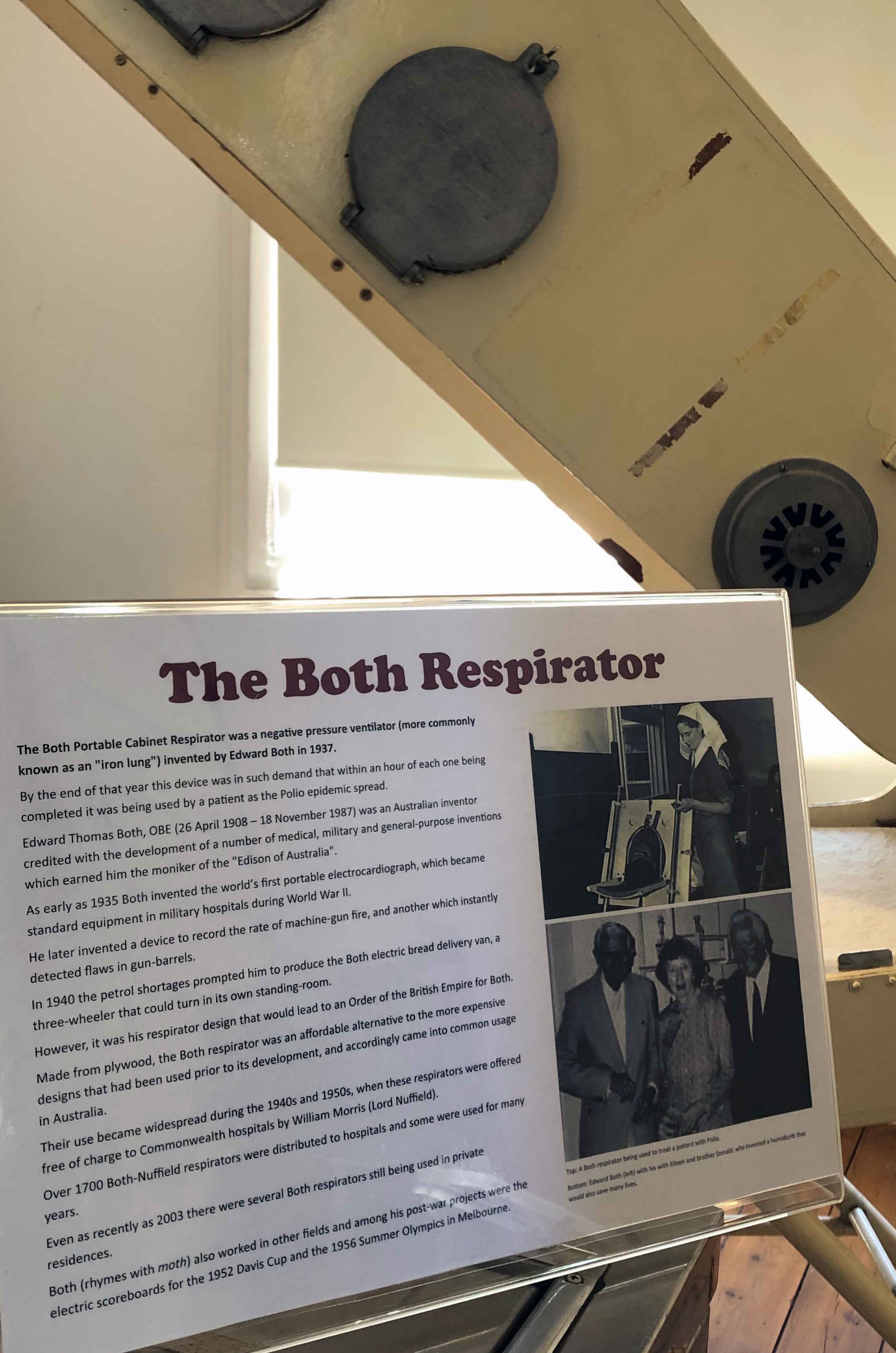
One of my first activities was to create this interpretive panel for their iron lung.
It surprised me as I'd already written about this item when I worked here six years ago, but returning to it I learned this is a Both respirator.
Edward Both was an inventor considered the "Edison of Australia" and he had a remarkable career in medical and military settings, as well as creating a scoreboard for the Melbourne Olympics.
This week I shared with a Studio Co!Lab what I've learned using the Cut-Up Technique
To begin my talk I encouraged everyone to print a copy of Picasso's poem about noon, since he's known to have stated that artists steal and it feels right to honour this contemporary of Cut-ups.
My Cut-up experiences have been realised in lyrics, sampling and also a book that invites destruction.
I also mentioned the poetry reading that I gave at a book launch which performed a live remix.
We began cutting Picasso's poem into individual words while I explained how the imagery reminded me of the Riverina and introduced David Bowie's use of the technique.
The singer acknowledged his debt to Brion Gysin and echoed some of the magical attributes he promoted with a process pioneered earlier in the 20th Century by Tristan Tzara.
My recollection is Cut-ups were a significant development in the split between Surrealism and Dada, when Tzara created a "manifesto" using newspaper clippings.
At the time the Surrealists were writing manifestoes and took offence at this brute process for generating words.
However, the cut-ups have been seen to share in common the influence of Freud's ideas of dream analysis as a way of identifying cues from the unconscious.
Cut-up documents interrogate the text in a haphazard manner that reveals as much about the dynamics and relationships of the reader, while allowing anyone to be an author.
In this way it shows a Dadaist antiestablishment attitude that can be seen as an attack on authorial intention.
Some might view the process as reassembling a document and the process can be viewed through a variety of philosophical positions, such as the magic and art roles.
When you begin creating a cut-up text there are decisions about the process that determine roles for chance or probability.
You might choose to draw a word from a hat, or you might assemble them from a visible pool of possible words.
My partner developed an exhibition that referenced William S. Burroughs' use of the Cut-up Technique in 2014 and that year introduced me to an alternate approach proposed by the Disquiet Junto.
While the process of preparing the pieces and then pasting them together has a meditative quality that suits gallery spaces that are open for more of a performance art aesthetic, the simplicity of the idea is ripe for technology.
It is interesting to see David Bowie returned to the idea as personal computing developed with the Verbasizer, which has been beautifully realised at this website.
The idea of cutting seems simple and it's worth remembering that many ideas about editing have developed since Tzara.
When you cut up a text the words are never entirely anonymous, even if the document become a palette for beige language.
Each discrete piece becomes a springboard for a chain of connotations, which is a process that has been called "unlimited semiosis" in semiotic theory.
These become potent symbols and through the popularisation by Gysin the cut-up practice came to be infused with ideas of magic that were researched by Genesis P-Orridge.
Burroughs undertook audio and film-based cut-ups that extended the ideas he identified in literary practice.
I explained an audio-based curse that P-Orridge detailed and how sampling harnesses a similar energy when it takes a small example from a larger whole.
Working with the landscape as a document to sample you find inspiration in selecting small symbolic examples to trigger memories of entire ecosystems.
Which l led into my discussion of my Soundscaping videos and exhibitions.
Using video as a medium for cut-ups led to the role of Arthur Lipsett's 21-87 in the development of Star Wars.
I pondered religious implications as well as broader philosophical questions of free will and determinism.
There were some questions towards the end, including some discussion of AI and machine-learning tools.
I talked about my collaborative poetry, where I fed lines about the environment into a website.
It offered results that were surprising in a way similar to cut-ups but overcame a key constraint.
The responses from AI saw angels, which was delightful and language that I never use.
So the AI experiment gave a nice counterpoint to the Cut-up Technique and Andrew, the moderator, decided that was the moment to end.
Along with the children I knew at one primary school, we all specialised in various forms of torture
One of the most common forms was vividly describing pain and letting the victim stew in their own tense juices.
At the time it was popular to give exotic names to the different styles of torture.
Jungle Torture, for example, involved inflicting a sequences of techniques that would ascend in their intensity.
This would begin with a series of tickling finger-flicks across the chest while describing ants, then progress to pummelling as elephants negotiate the terrain of the victims torso.
Some of the most severe actions came from Asian countries, such as the wrist burn attributed to the Japanese.
It would involve the torturer grabbing a wrist with both hands, then twisting in opposing directions.
My skin was supple back then and I don't recall it caused more than a brief rash, but now I wonder if my dry wrist might catch and rip open on that bony bit that protrudes.
However, there's something about anticipating the touch of my torturer that also feels different now.
I hold hands so rarely with anyone now my kids have grown up -- and not because I scared them away with wrist burns!
My body feels a bit tingly just thinking about someone grabbing me.
Another approach might be Chinese Water Torture, which uses dripping water to slowly frustrate then irritate then madden a victim.
Thinking about this while I lay in the bath recently hearing the shower head drip, I realised it seems underwhelming.
I expect the sound of dripping would barely register among the hum of daily life or even my tinnitus.
The tortures I knew as a child all seem out of date.
Now there's something appealing about the idea of being touched or having enough silence to find dripping water sound loud.
And, of course, the real tortures of waterboarding, electro-shocks or locking-up refugees on remote islands has been well-documented.
There seems to be a lot of backward-looking music these days
Triple J, Australia's youth radio station, had their Hottest One Hundred on the weekend and, while we were listening my brother observed how many more tracks this year were covers or remixes.
I told him how my new favourite critic had a similar observation of Tiktok's trend for earworms made from snippets of nostalgic tunes.
Ted Gioia has written that younger audiences find it comforting to hear the same songs, as well as bemoaning the limit this places on music discovery.
It prompted me to reflect on those pop songs that I'd hated hearing until, after memorable moments on dancefloors, they became triggers that allowed me to re-experience ecstasies.
So I'm now experimenting with making memories.
On the weekend I tested the role of music in becoming a soundtrack for moments (or making moments from soundtracks?) when I drove my son from home.
He's moved to the city to start uni and we packed stuff into his car and drove for hours to a much larger town.
As we were leaving I thought to grab a CD for the drive and reached for my favourite purchase of 2022, The Avalanches' latest album.
While I've been a longtime fan of the group, I didn't immediately jumped on their last couple of albums.
It wasn't until 'Red Lights' popped up in the credits of a TV show that I remembered I was going to give them a listen, then it was a pleasure to hear their return to form.
Given the gap between albums for The Avalanches (and the diversity they like to show while playing live), I'd had doubts whether they would still meet my expectations.
It's great to find things where you left them!
So, anyway, my son and I were driving from home and the mood was tender.
Rather than listening to the radio, where you run the risk of news headlines, I thought music would be better for reflection.
The album "We Will Always Love You" is kind of a twist on the theme of The Avalanches first album, "Since I Left You" in being about distances.
Where the original trumpeted the joys of travel, this return-to-form is about missing people.
While we listened to it, I think we got to the third song, when my son asked "Did you have to pick an album about leaving?"
I told him that this is how memories are made and that I wanted to remember this trip with one of my newest favourite albums.
I recounted the ripple-down-my-spine that would accompany listening to The Bird after I saw them live, or how the songs I thought were drivel would weirdly become irresistable gems on certain dancefloors.
Then, as we passed a harvested field of stalks with red dirt showing through, a dust devil spun toward the road and I remembered how my Wiradjuri friends would say those show when spirits are visiting.
I'd heard that at a farewell for a friend and now began to wonder if she weren't giving us a wave on our journey, then the tears sprouted from the corners of my eyes.
We listened to the beautiful music.
Anyway, when it came time for me to leave my son and return home, I left the CD with him.
I hope he'll put it on while watching a sunset and know that we're seeing the same sight.
In the meantime, I can tweak the raw nerve of his absence by listening too.
One more bit of The Avalanches theme of our weekend, while my son and I were indulging in our shared love of shopping at secondhand stores, we found a copy of Koichi Oki's "Yamaha Superstar" for six dollars.
He enjoyed it, but that shouldn't be a surprise since it's all covers!
My daughter likes Christian Bale in American Psycho and Mads Mikkelsen in Hannibal


Of all the possible things that I couldn't have predicted would happen in 30 years, that I'd be watching a film adaptation with my family and seeing my daughter dress as Patrick Bateman for halloween really shows how little time travel I've taken.
Here I am performing poetry “with an avant garde twist”

I recorded this version of the piece the following day:
Photo by Neil McAliece.
