Gradations with u

Normally I hate graduations and have skipped them whenever I can

There's long been a sense for me that they're fake and, while wanting to be well-meaning, they offer empty platitudes with small slices of bland sandwiches after a flavourless ceremony.

Maybe that speaks more to my own experience, as it probably began when I spoke as Chair of the School Board at my graduation and then went on unemployment benefits for four years rather than finding a world of opportunity.

Then, four years after finally accessing the financial support to study, I refused to wear a gown to my uni graduation and found that lots of people told me that I looked better for dressing differently.

It was an experience that might have hardened my aloofness and desire to be distinct from whatever everyone else was doing, which honestly mightn't have worked out so well in the long run.

I've changed careers a handful of times and it feels like that restlessness has been speeding up.

If there's one thing that's kept a sense of regularity since I stopped owning a dog, it has been being a parent.

This role has provided so many opportunities to revisit those difficult memories of being a child and find a new perspective that's sympathetic toward my own parents.

Therapy would have been cheaper and now I wonder if my own children will begrudge me for moments of selfishness or recognise the struggle to keep sane as obligations multiply and come into conflict with our lives together?

Anyway, today I went to my child's graduation ceremony and came away with a very different experience.

My daughter wasn't the first of my kids to finish high school, so I didn't have the shock of wondering why her class was so small.

At our regional high school it seems more than half the class will leave at the end of Year 10 to find jobs, apprenticeships or maybe they move away for opportunities in a city.

My daughter didn't get singled out for achievements, although academically she is as capable as her older brother, who was awarded cash prizes at previous ceremonies that I'd been dragged along to watch.

The Principal spoke predictably about how this class of students arrived five years earlier as children and were now leaving as young adults.

Ha, I thought, what a world they’ve got to find their way through.

Then she recognised that something significant happened in Year Eight, when everyone had been forced to learn how to study online.

There was a worldwide pandemic that saw the stocks of Zoom rise and gave me a firsthand observation of how differently my children approached their studies.

My oldest child struggled without the face-to-face opportunities to be assured he understood the expectations of an assessment.

My youngest seemed to get everything finished within an hour and spent the rest of the day in Minecraft.

My daughter, a middle child, was often so quiet as to be unnoticed.

She would retreat to her bedroom and I began to recognise her resourcefulness, as she never asked for assistance and clearly had observed that Google had all the answers.

When I enquired about assessments she showed me how a group of friends negotiated in a messaging application to divide the workload.

I saw this chat group was named "Boomer remover" and callously admired the dark humour as the casualties began to rise.

Now at her graduation, I listened to people occasionally coughing around me and wondered if I was going to catch COVID again.

Many don’t acknowledge the pandemic continues.

My reflections were disrupted by movement on the stage as the speeches that blah-ed in the background came to lull.

A couple were moving with long hair that looked like something from a time before I had hair of my own.

A young man with a mullet, then a young woman took to the podium with flat long flowing centre-parted hair, that's the style of the day again it seems.

Young Mullet recounted how they'd been told they were the worst Year Seven in 25 years, while Centre-Part spoke about how they had been able to observe changes in their year advisor as he found love and got married.

There was a weird sense that something shifted in me, as I realised the kids had been watching as the world stopped and was restarted.

They had likely also wondered if anyone knew what they were doing while a defining moment in our lives entered every house and then was swept aside by the rush to resume regular life.

Often it seems a dissonance to hear people minimising the risk of lifelong debilitation with a phrase like "spicy cough" so their aspirations can fly again to holiday in unimaginative destinations.

And it occurred to me that this is the way of things, like seasons changing, inevitably cycling through changes that feel like gentle progress while really remaining on the spot like pedalling on an exercise bike.

My cynicism concluded that classes keep graduating and people keep standing behind podiums telling people there is something to look forward to.

Then the most unlikely thing happened, the graduating class danced out of the auditorium.

I don't know when choreographed dancing at graduations became a thing and I suspect I might have seen it at a previous ceremony and thought it was naff.

However, today I looked into 41 joyful faces and didn't see a single cynical outsider pretending to go through the moves.

It was remarkable that a group could agree on music, let alone the steps to go with it.

The graduation program listed names of students that I'd been hearing since my daughter joined kindergarten and, as I looked around, the parents' faces I'd known from attending assemblies all looked older.

That's one thing that's different from my schooling, I went to five different schools and my daughter has only known two.

I wondered if this little community in the Riverina had provided something more than being little.

We walked outside into the sunshine to find the students talking excitedly in small groups.

People posed for photos and I had the strangest sensation of excitement for the possibilities these young people have waiting for them.

So much is changing and there have been challenges, yet the kids have grown up and I realised that I had too.

My own relationship with schools is about to be approached from a new angle, as I prepare to enter classrooms as a teacher.

As I reflect on how much I've resented sitting through school assemblies and speeches for decades now, it comes as a shock to realise that I will have opportunities to be that blahing voice at the podium after I graduate.

I hope to have the same enthusiasm and excitement that I have seen on the faces of students.

Maybe I will know that mask-like smile that I see teachers wear during public events at schools.

Or perhaps I should recognise the times have changed and learn to dance?

Time really does move in circles, lapping seasons and ticking over years.

Each revolution brings a new perspective on the next.

I just need to keep learning new moves to stay relevant.

Yes, Minsiter

First they came for the subeditors, and I did not speak out—because I was illiterate

That look

I was hanging washing on the line this afternoon

The sparrows in the yard sounded agitated, then I saw this one caught on a branch.

I took a few photos since normally one doesn't get close to these flighty birds.

Looking over them and it reminds me of Howard Arkley's Nick Cave painting in the National Portrait Gallery.

The way everything is soft except the light reflected in the eye.

It is dizzying to stand too close to Arkley's work.

If you let it fill your outlook, one's eyes try to reconcile the depth of field.

Something about that uneasiness always seemed poignant while remembering Arkley died from an overdose as his career was taking off.

Just as it now was unsettling to watch the sparrow spinning around trying to take flight.

Don't let your dreams give up on you

Collage by Austin Kleon — who doesn't credit the fourth grader that allegedly spoke these words

Although, now that I think about it, Kleon has a book called Steal Like An Artist so he's probably on brand and practicing what he preaches!

Roo Cop

By brb

Overcoming distance education hurdles

Earlier this year I got a scholarship to train as a school teacher

It's been fun to go back to uni, although I am conscious the attrition rate for distance education is higher than that for students studying education -- so the challenges must multiply!

One of my assessments for uni this semester is the aptly-named "hurdle" worth 0% that involves sitting the LANTITE test required of teachers to demonstrate literacy and numeracy.

This test uses a remote proctoring service based in the USA for regional students and was posing problems for my laptop's RAM and home broadband.

After I saw the Country Universities Centre promoted having high-speed broadband, I joined up.

(I had resisted previously because I don't need their other services and who wants to be associated with an acronym that sounds like cuck?)

So it was disappointing to discover their broadband connection in Leeton was worse than the one I have at home. 

Australian internet often leaves a lot to be desired and service providers have been criticised for promoting speeds that don't reflect the bandwidth available to users during peak times.

Anyway, I think I've found a solution for my final LANTITE attempt today for 2024.

I reduced the screen resolution from 1920 pixels to 720 and now the proctoring service's test says I could host four students on my connection!

Now I'm wondering if I should offer my caravan as a study centre? 

Halloween exam

Amused by this requirement while I attempting to log into the LANTITE exam on Halloween

Are the two sheets so that I can make a ghost costume?

Or perhaps they're going to check my Origami skills?

It seems weird that I can have two sheets of paper but nothing for making a mark!

Where did the bands go?

Rick Beato raises an interesting observation here about how few contemporary bands appear in the charts

I think one of the things he misses is that pretty much all of recorded music is available online. In the past albums would go out of print, unless they were really popular.

The other thing is that contemporary music is so much more competitive, with that many more artists and they don't get the budgets and experience available to previous generations.

(Part of me is amazed at the older stuff that my kids listen to, but another part of me ponders those two points above.)

Another factor influencing their ongoing success might be that by the 1990s many bands had stopped touring material before recording it, which means they wrote and recorded songs without performing them for audiences and missed having that opportunity to fine-tune structures or develop material beyond to be more memorable.

And, yet another idea, the demise of bands fits within a broader trend identified in Bowling Alone: The Collapse and Revival of American Community, a nonfiction book by Robert D. Putnam published in the year 2000. (After all, Regurgitator sang that "Music is sport!")

Peed off

Sometimes I wonder why I always need to wee, then I remember that I use questions like this one as a prompt to make a cuppa

There really are too many questions in a day, I think.

Recently I read that teachers make an average of 1500 decisions each day and I know that for me this will be mostly deciding not to drink cuppas since I can't wee during classes.

Dear artists

Creative expression is part of my weeks, though not as daily as it used to be

I like writing to work through thoughts and making music to forget others. 

And playing drums or dancing for 10 minutes is a mood-changer.

Collaborations

Music has always been the key requirement for membership of an online colony, along with English for me

The earliest was the Ninja Tune forum that introduced so many remixing techniques, which continues in the Shinobi Cuts Remix Chain albums.

In the last month I've had a couple of collaborations with my online communities, particularly the Disquiet Junto. The prompt to compose with a 29/16 time signature arose from a conversation with Oscar about the Mother 3 video game.

That led to two tracks and the second became a soundtrack for a walk-through the Marea Bright exhibition at the Museum of the Riverina.


Naviar Records shared my senryu this week and it led me to filter the noise from a South Coast video.

Pain in the arts

This morning I listened to a discussion about engaging men in the arts

I know it seems weird, given how men are disproportionately represented in galleries and earnings and other metrics.

Yet, once you get past the marquee banners outside those institutions and the million-dollar prices in auction houses, there are less men involved.

Particularly when you go beyond leadership roles or anything that might convey status.

And it was obvious in the Zoom session that, aside from the panel and one gender-ambiguous name, I might've been the only male in the audience.

In fact only three of four men promoted as being on the panel showed up!

So I asked a few pointed questions about the opportunities for men to engage with the arts and hoped to get a conversation going.

For example, I questioned whether education is to blame as a lot of the exercises I see in primary schools are largely paint-by-numbers-type activities rather than processes that encourage reflection.

It's the way that practicing art prompts me to acknowledge my emotional well-being that I think points to the greatest benefits of promoting creative activities.

I mentioned how liberating it is to make art in a regional area and also shared my favourite quote:

“Amateurism,” says Sharifullin, “is what defines provinciality. On the other hand, it’s hard to stay professional when you’re surrounded by philistine stereotypes. People think you’re a weirdo if your happiness doesn’t depend on the size of your bank account. So you must have balls of steel to do arts. It’s not that bad if you have a few like-minded people around, though.”
After the Zoom session ended and I'd been for a walk, I reflected on the subject by thinking about my sons.

There's a distinct difference between the oldest and the youngest when it comes to creative practice.

One of them is an active writer and singer, while the other has hated art since he started school.

Then it occurred to me the former is less self-conscious and perhaps more confident in making art, while the latter has often looked for approval from peers.

As I pondered this I returned to the idea that "you must have balls of steel to do arts."

Could it be that men don't engage with the arts because they don't feel confident?

It brought to mind the powerful observation from bell hooks in her book The Will to Change:

The first act of violence that patriarchy demands of males is not violence toward women. Instead patriarchy demands of all males that they engage in acts of psychic self-mutilation, that they kill off the emotional parts of themselves. If an individual is not successful in emotionally crippling himself, he can count on patriarchal men to enact rituals of power that will assault his self-esteem.
 

Night At The Museum

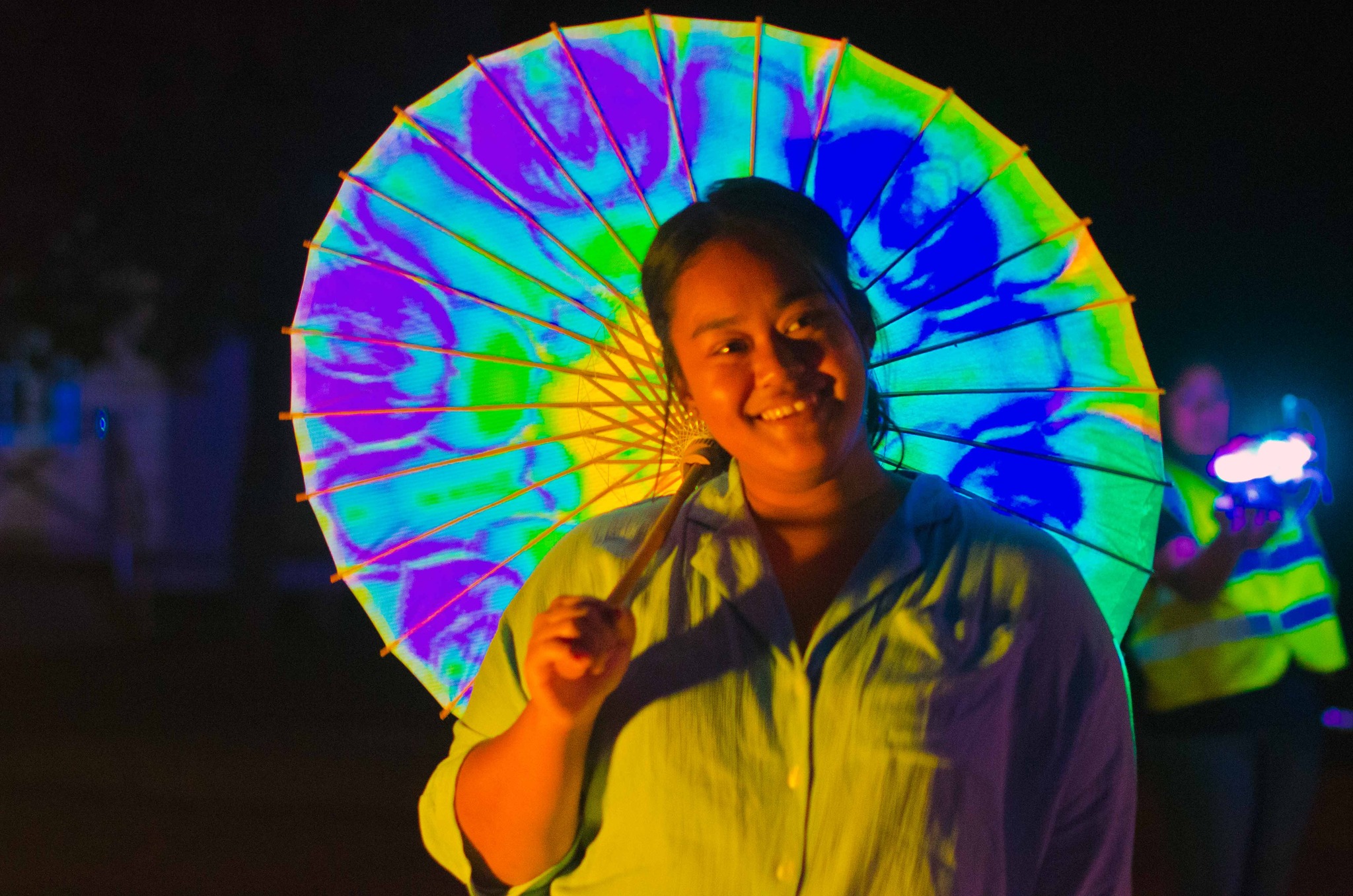
Griffith Pioneer Park Museum's first night time event in living memory was an explosion of colour

Projection artists worked alongside a cohort of local students to develop the Night At The Museum event with Riverina-based arts organisation Red Earth Ecology and visitors the Bioluminescence Project. 

The Museum's historic and replica buildings were bathed in large-scale animations with a variety of styles and materials. 

Locals Andrew Keith and Bernard Gray were joined by regional artists Jason Richardson and Greg Pritchard. 

Scott Baker returned to Griffith to run workshops in video projection-mapping and digital file manipulation. 

The group of eight also learned skills in design and event management for the public outcome on Saturday night. 

An audience of over 160 people from all ages attended and were able to appreciate the diversity of projection art techniques. 

Mr Gray was demonstrating live-coding, while Dr Pritchard showed material from his project recording the Murrumbidgee River. 

"It was beautiful to see Greg brought the River to the old Baptist Church building," said Jason Richardson, event coordinator and Museum Curator. 

"Scott and I were also happy to be joined by Andrew Keith, who attended the first projection-mapping workshop that we ran in Griffith back in 2016." 

The opportunities for night time events at the Museum offers a range of possibilities at a venue traditionally used during the day. 

"The buildings provide a wonderful environment and we'd love to see Griffith continue to host showcases for projection art in the region," said Mr Richardson.

Night At The Museum was supported by Griffith Pioneer Park Museum, Red Earth Ecology, Western Riverina Arts and Create NSW through funding from the NSW Government.

Art at the heart

I am a believer there is more in common with art and sport than what divides them

This was an argument I wrote earlier on here, which is becoming a theme as a share this article that a friend recently posted online.

There was a piece in Crikey along these lines a few Olympics ago, but I can't remember the millions of dollars for each medal in that assessment.

From my perspective the real value in investing in sport or art is getting the broader community involved.

Imagine how much everyone would gain in their physical and mental health if Australia invested the millions that go to elite sport into programs for accessible arts?

Opportunities for haiku

This is a summary of the presentation that I gave for the Haiku Down Under event last weekend

My aim was to outline various creative strategies for using haiku as ekphrastic, either in responding to other media or being an inspiration for new material.

The presentation outlined opportunities to incorporate poetry into exhibitions, collaborations, music and other approaches to art.

I introduced the work of Garlo Jo and Marco Sebastiano Alessi with discussion of an interview with the former and was joined by the latter for the second half of the presentation.

One benefit of exploring activities like those I promoted is to raise the profile of poetry and help a wider audience gain those benefits familiar to each of us as writers of short reflective works.


When the going gets weird, the weird turn prose!

The title from my session came via self-described “gonzo journalist” Hunter S. Thompson, and it’s an energy which reflects my gonzo approach to haiku: “When the going gets weird, the weird turn pro.”

It led me to give a quick word about definitions, particularly my looseness with them, as I am kinda brash and move fast, so some ideas and definitions tend to get broken along the way — which is a character you’ll see that I’ve embraced in my practices.

I work quickly and don't get too caught up with following rules.

However, early on in the discussion I saw a message from Amelia Fielden in Zoom's chat that kinda derailed me, as she commented that I shouldn't pluralise haiku as haikus because that wasn't how the Japanese would do it.

"Please stop saying haikuS. The word haiku is both singular and plural and does not take S at the end (for plural)"
I explained my approach is probably American and reflected on Kerouac's statement:

“The American Haiku is not exactly the Japanese Haiku. The Japanese Haiku is strictly disciplined to seventeen syllables but since the language structure is different I don’t think American Haikus should worry about syllables because American speech is something again."

Not sure if it helps, but my parents were both born in North America so maybe that's part of my heritage.


Introducing Garlo Jo from Bourdeaux

I met Garlo more than a decade ago when he contacted me on Facebook and asked me to contribute to his Vent de Guitares project.

If you own a guitar, it’s a technique that worth trying — use an open tuning and allow the wind to vibrate the strings. It’s a generative approach to music.

Garlo was invited to develop a project in Japan during the mid-90s using this approach and it was there he became interested in haiku.

“In Japan I understood the importance of haikus. A Kyushu newspaper had a haiku each week-end and before the concerts we organised a haiku contest. Maybe haikus is a way to feel nature, even in a big city like Fukuoka, you can listen to the wind by means of bamboo, flags and furins… and haikus.”
A haiku competition was developed to complement his musical project and I think that's one good strategy to incorporate poetry into other events.

Garlo followed the project in Japan with the development of his CD 99 Haiku.

“On the CD, each haiku is related to the haiku before by its evocation or by the music. You can listen to my progression or make your own progression.”

This is a good generative idea, a kind of choose-your-own-arrangement. It’s something I want to highlight here as a theme.

“I focused on French and Japanese. I think that the ideal way of listening to this CD is to have one and only one haiku each day for 99 days. A radio station in Kyushu broadcasted the CD that way. It has 99 haikus because 99 tracks is the limit for CDs."
 

Introducing Crossing Streams

Next I discussed my first experience using haiku in an exhibition for Crossing Streams, which was a collaboration with Marco and the Naviar Records community.

Local writers were invited to contribute to the three-week event in Narrandera during October 2017 and contributors ranged from age eight to eighty-something.

I ran workshops to help develop this material and then illustrated the submissions with my photography.

Working with Marco we selected five poems to be shared with the Naviar Records community and the result was over five hours of original music that was played in the exhibition.

One of these was my first recording using Garlo’s vent de guitar technique in response to a haiku by Peita Vincent.

Also exhibiting was a project developed by Dr Greg Pritchard, who shared his collaboration with weaver Kelly Leonard and also ran a workshop as part of the program of events.

Poetry as a micro-journal

My interest in writing haiku began in 2001 after I moved to Wagga Wagga and got my first mobile phone.

The Short Messaging Service (SMS) function led me to start broadcasting short poems to friends as a way of sharing my observations about living in a new city.

This foundation was based on the seventeen-syllable approach suiting the 140 character limit of SMS.

The microjournal approach developed further in 2016 when I made a new year's resolution to write one each week, then increased from 2017 when I began writing one each day.

These were published on a blog.

It was a creative practice that became useful for generating content.

A body of content provides material you can utilise in a variety of ways, and I’ll outline some ideas that I’ve used.

One idea is rensaku, which I believe is the term for a sequence of haiku.

This was the approach used in my poem River Of Time that was published in the Poetry for the Planet anthology.

These kinds of sequences are also interesting to capture the mood of a year, which I’ve done a couple of times by selecting examples from my microjournal and stringing them together.

Another approach was using haiku with photographs  as part of an exhibition at Griffith Regional Art Gallery in 2019, which I also published as the book Earthwords. 

The book that developed from an idea that was irresistible to me, incorporating the Cut-up Technique to invite the reader to cut the pages to generate new poetry, either through deliberate selection or random collisions of phrases.

As a writer I liked the way that sometimes so much can be achieved just by swapping the last and first lines.

For more about cut-ups and their history.


Introducing Bassling

Bassling is my musical pseudonym and haiku have played a role.

The cut-up idea was one I used for a performance at a book launch, which I also recorded for the Naviar Records prompt that week.

One more approach to using haiku is the lyrics for Ghostly Melody.

Haiku can require editing to sit into music as lyrics, but can offer great raw material to work into a song.

In conclusion

Haiku and other forms of poetry offer benefits in terms of being a reflective writing practice and it's worth raising the profile of these activities to engage an audience.

There are strategies for stimulating writing, such as adding haiku competitions to other events.

The material produced through writing haiku can lead to a variety of outcomes, whether exhibited or edited into other formats.

My examples included stringing haikus together to make rensaku-style pieces, as well as using the Cut-up Technique to create new material from existing phrases or as a performance.

I have also used haiku as raw material to become song lyrics.

Dancing across generations

Dancing was part of my studies as a primary school student

It was incredibly unpopular as it involved old-fashioned folk dances and hand-holding while moving around a circle.

Unlike how learning music at school led me to avoid taking any lessons for all of my life (yet I now have over a dozen solo albums), I did seek out breakdancing lessons at the local YMCA and learned routines.

However, it’s a different experience for my kids and it’s unlike my upbringing because I never saw my parents dance together.

In comparison my family engaged in dance battles in the kitchen some nights.

So it was obvious to me how social dancing took a massive leap with the popularity of the game Fortnight.

It was surprising to see my youngest son took steps to imitate the characters, even though he was too self-conscious to dance for a long time.

When we were at a Burner event one time and he refused to dance, I encouraged him to just floss a bit and he got such a reaction that he soon moved to the centre of the dance floor.

Night At The Museum

Griffith Pioneer Park Museum will be seen as never seen before at a night-time event on Saturday 7 September 

Projection artists will bring vivid colours to the historic buildings in a showcase of dazzling technology. 

The line-up will include Griffith’s Bernard Gray and Andrew Keith, whose live-coding skills have been a feature of events in Banna Laneway and the local Art Gallery. 

Dr Greg Pritchard will be returning to town and he is arguably one of the earliest proponents of projection art in Griffith, when he exhibited his skills while working as the inaugural Regional Arts Development Officer for Western Riverina Arts. 

Joining them will be a full class of emerging talent gaining experience under Scott Baker’s tutelage as part of the Bioluminescence Project that has been touring NSW this year. 

“We’re stoked to bring Scott back to Griffith after the cutting-edge projection workshop he ran at the Museum in 2016,” said curator Jason Richardson. 

“It’s also wonderful to add new colours to the landmark location of Pioneer Park Museum.” 

Mr Richardson has been active in the Riverina, from adding a projection event to the first Leeton Art Deco Festival in 2011 through to coordinating the InFrequency tour that played events in Yanco and Tanja with many of the same artists involved in workshops and performances. 

“I helped establish Red Earth Ecology as an artist-run not-for-profit to develop opportunities in the region,” said Jason Richardson. 

“This year we’ve sponsored a community-driven photography exhibition and also delivered our Beak Technique workshops, both as part of Griffith’s phenomenal Action Day event.” 

The Night At The Museum event will be Jason’s final activity at Griffith Pioneer Park Museum as he leaves the role of curator. 

“It’s wonderful to bring colour to this exceptional community-based organisation and I hope everyone will join us in seeing the Museum in a new light,” said Mr Richardson. 

“You can bring a torch to add your own light and it will assist families with exploring the event.” 

Entry to the event from 7-9pm on Saturday 7 September is by gold coin donation and attendees are required to wear suitable footwear to navigate unsealed pathways at night 

Snacks, refreshments and soup will be available for purchase. 

Night At The Museum is supported by Griffith Pioneer Park Museum, Red Earth Ecology, Western Riverina Arts and Create NSW through funding from the NSW Government.

Can a gun make you gay?

"We should write a book about being gay and owning guns, so we can ask if the guns are making readers gay." -- Will Wonka

Fore(gone)sight

One of my favourite moments in Star Wars, a film which admittedly has many moments, is when Obi-Wan Kenobi instructs Luke "your eyes can deceive you, don't trust them"

Humans have at least five senses but sight dominates our lives.

It's been a frustration for me as an interdisciplinary artist that Australian galleries focus mostly on visual media.

It's also been an interest for me as a way to explore opportunities, such as soundtracks for exhibitions or blindfolded tours.

So I'm interested to see that pommel horse champ Stephen Nedoroscik takes off his glasses when he performs. “It’s all about feeling the equipment. I don’t even really see when I’m doing my gymnastics. It’s all in the hands — I can feel everything.”

This also relates to my earlier observation about the shared aspects of art and sport, particularly how they're united in culture.

Many athletes talk about not-thinking when they’re at play. 

“I have to focus on not thinking,” says gymnast Simone Biles. 

“If you think about a trick, sometimes it makes it harder,” says skateboarder Minna Stess. “When I’m skating, the best thing is to not think at all.”

It reminds me when I'm at a life-drawing class, as soon as I start to think too much about the picture as it takes shape, it will begin to fall apart.

Likewise, I get into the flow state of creativity by being in the present and not worrying about the result.

Seeing is believing, says an adage that's clearly out of date with our world of digital manipulation.

I think seeing is easy to rationalise and also to assure agreement with those sharing a view.

However, I am a believer that appealing to other senses can be more persuasive.

My partner, for example, gets amazing results from smelling good and her exhibitions have included tactile exhibits that defy sight by asking people to put their hands into prepared boxes.

And my sister's cooking is another remarkable skill, which has led me to incorporate cooking into my gallery events through my love of sharing new toasted sandwich recipes.

Sport, like art, are components of our shared culture and I want to encourage everyone to explore their senses.

Mad skills

It takes a special kind of skill to write questions as poorly phrased as these

Vale varnish wattle

Our varnish wattle got blown over

It was the third generation of a family that have slowly moved east from their original planting alongside the carport. 

The current location wasn’t ideal, as it meant walking off the path and caught on the clothesline, but I am sorry we won’t be watching the puffy blooms herald the start of another spring.

Live foley sound

It was a series of invitations that led me outside my comfort zone

My partner had been asked to speak at a breakfast event and I thought I would show my support by going along.

Her talk was sensational and, although the breakfast was not my usual thing, I had an opportunity to talk with one of our town's creative luminaries.

She was in the process of rehearsing a play for a town festival that promotes Art Deco and the interwar era of the 20th Century.

It was interesting to learn how Leonie had taken lessons from her previous production and arrived at writing a radio play, which allowed the actors to use scripts onstage.

When live sound effects were mentioned she had my full attention.

There was a challenge with ensuring these props could be heard and, after I spoke about the potential for contact microphone, she asked if I was interested in becoming involved.

Sure, I said I'd have a look and see what assistance I could offer.

After a few ideas didn't work, I found the actor providing the foley sound was keen for help.

As I kept going to rehearsals I became part of the play.

It was my first dramatic performance since Ye Gods in year seven at Woden Valley High School and I had a lot of fun.

Photo by my brother Will Macleod.

Railway crossing

One of the things I like about my suburb is the proximity to trains

It's wild how diesel locomotives cross the road on the way to the supermarket and surprising there are no level crossing boom gates.

The train blasts the airhorns and pushes into the traffic, because who is going to argue with one of these colossal carriages?

Australian culture

It was Tuesday 8 June 2021 when I met Ken Dray, Senior Policy Lead, Policy & Partnerships for Create NSW

Western Riverina Arts had invited a group of locals to a discussion in the Leeton Museum and I asked why sport and the arts were often presented as opposites, when they clearly have so much in common and are united as being cultural activities. 

Ken thought only France had a Ministry of Culture that housed both. 

Anyway, I was thinking about that conversation now we have the NSW Department of Creative Industries, Tourism, Hospitality and Sport. 

Australian culture is sometimes presented as a joke, but I think it's significant that we are the meeting point between the oldest continuous culture recorded in human history and one of the newest, as well as most multicultural.

Many people are surprised when I point out that the Western Riverina region is the most diverse community outside of western Sydney.

My worry is that "creative industries" is too often presented as services like graphic design.

Everyone benefits from engaging with the arts and it needs to be recognised as something more significant than some form of consumption like reading a book, watching a film or buying a souvenir.

Justice for all

"Social justice" is a term in my school reference from the end of Year 12

At the time I was the Chair of the School Board at Lake Tuggeranong College and had lent support to promote various concerns that included seeing condom-vending machines installed in toilets. It's interesting in hindsight that the assistant principal who wrote the reference identified that quality as it has continued to be part of my activities in various communities from lobbying and campaigning through to informing my creative practices.

Over the last decade I've been based in the town of Leeton and put some of my energy toward raising concerns for the benefit of everyone, as well as demonstrating a passion for teaching. I have volunteered my time to campaign for improved services based on the need for equality, particularly in health services and education.

As part of a small group I drew attention to the shortcomings of the local hospital, which is often without a doctor on duty. This included generating media interest and also chairing a public meeting that drew an audience of over 100 people to the neighbouring town of Yanco, as well as elected representatives from the three levels of government. That led me to volunteer my time during elections to support candidates addressing issues of public health, as well as distributing materials to improve funding for public education after the Gonski Review.

There have been various opportunities to share my knowledge and experience with the community. One of my first initiatives while working as a Corporate Communications Manager for Leeton Shire Council was to develop digital capacity in the community, including workshops to assist businesses in getting online (some tourism operators didn't have email at that time) and also demonstrating digital media techniques through workshops. The latter included showing photo-manipulation to children as a school holiday activity at the library and led to developing workshops supported by the regional arts board in using free software for editing digital media.

My skills in developing communications have been part of working in various roles to support community groups and, in turn, has led me to be a founding member of Red Earth Ecology. This organisation provides support to curate exhibitions that raise environmental concerns, as well as being a way to promote the benefits of engaging with art. As a not-for-profit we have used the funds generated through our activities to sponsor a photography competition currently exhibiting, and the Ngurambang exhibition at Griffith Regional Art Gallery last year included a series of presentations to high school students about historical and environmental themes including colonialism and geology.

My experience in producing exhibitions led me to work as a curator in a community museum, where I have found opportunities to engage locals and improve the representation of First Nations history through displays about topics such as Murray Cod and pandemics. I am currently assisting with a projection-based public outcome with the Bioluminescence Project that will focus on the environment through manipulating digital media.

Finally, I think it shows that my interests have aligned in my role as Community Representative for the Griffith Base Hospital Arts Working Group. In this position I have agitated for various outcomes, such as ensuring communities throughout the region have been consulted and that local artists can be considered commissions, gain experience and contribute to the permanent displays.  

This is a statement prepared for a recent application and I thought I may as well post it here as well.

Recent project

The next exhibition in the Griffith Regional Theatre’s Artspace will showcase local photography and an historic occasion when it opens on Monday 24 June 2024

Featuring entrants from the Griffith Pioneer Park Museum’s 2024 Action Day photography competition, these photos from visitors on the day capture this beloved community event.

“Around 3,000 people enjoyed the day and it was one of the biggest Action Days in recent years,” said Griffith City Mayor Doug Curran.

Traditionally held on the Friday before Easter, since 1971 the Griffith Pioneer Park Museum Action Day has seen the old machinery in action, and the displays that celebrate the history of the region brought to life.

Attendees this year were invited to take photos of the Action Day, and dozens of these images capturing various activities will now be exhibited as part of a competition that will be decided by votes from visitors to the exhibition.

Prizes were sponsored by Red Earth Ecology, a not-for-profit artist-led environmental organisation, who are keen to encourage everyone to engage with the Museum’s significant role in the Riverina landscape.

The Under 18 Category winner has already been announced, being James Favero.

The photographers competing in the Open section include Simone Borg, Emma Kenny, Neil McAliece, Sarah McCorkelle, PJ Lale and John Samuel.

The images have already found an appreciative audience among the staff and volunteers who worked during Action Day.

“We’re so busy focusing on the event that we often don’t get a chance to see all of the attractions,” said exhibition curator and Pioneer Park Museum staff member Dianne Silvester.

“It’s wonderful to see so many people having a great time.”

Theatre manager Marg Andreazza said, “We love using Artspace to exhibit local artists, and this particular exhibition is great because it features photos of a much-loved local event, taken by local people,” Ms Andreazza said.

The Action Day Photography Competition Exhibition will be on public exhibition from Monday 24 June until Friday 16 August with winners notified after it closes. 

Switching gears

Recently saw this observation about writing and thought it's something that extends to many creative pursuits

"Recklessness and rigor" is one way to identify those flow and critique processes, which can be seen to embody first and latter drafts in writing. 

It's something that Michael Stavrou addresses in his book Mixing With Your Mind and he frames these as left and right brain activities.

While this metaphor doesn't do justice to the way our brains operate, it is a really insightful discussion for the proposal that creative people benefit from grouping likeminded tasks.

For example, if you're writing and in a state of flow, then the process can be disrupted by needing to open a dictionary and find the appropriate word.

Someone like Julia Cameron in her book The Artists Way, I think, would likely say to keep writing -- even if it's just repeating the word until the sense of flow returns.

That's the kind of recklessness one can indulge while writing a first draft, before returning at a later time with a more critical perspective to finesse those words with the rigor required for publication.

And I think there's a similar distraction from producing work when a person begins second-guessing what they should be doing, although that is likely more akin to Sartre's notion of "being for others".

Best cheese lately

Thought I should balance my negativity about those Twisties by sharing my enthusiasm for sheep cheese

This has been a favourite in recent months and I was happy to find it half-price at the stupormarket.

I am so grateful to live in an age when truffle has become so plentiful.  

(You can find it flavouring chips!)

And cheese is so often wonderful.

Flashing

Life drawing last night with Jo was surprising

It was the first class where I felt confident to flirt with the model, but nothing could prepare me for the eye contact. 

Usually the model is staring past me and not smirking about the muzak playing Duo Lipa as an instrumental.

When I get to the point of having my life flash before my eyes, I expect I'll see a lot of Jo.

Asleep at the handlebar

I've been reading Craig Mod's account of walking the old Tōkaidō Road and the photo here is one he shared

It brought mind the time that I fell asleep while riding my bike.

I was returning home from a party in Canberra around 4am among frost and probably too drunk.

Between the Governor General's residence and Scrivener Dam is a tunnel that leads under Lady Denman Drive.

It would've been in that tunnel that I had a micro-sleep, as I awoke to the vibrations from straying off the bike path and found myself passing through the trees among the grassy slope that drops toward the Molonglo River.

Anyway, it wasn't something that I'd recommend!

I am, however, impressed with the fellow in Craig's photo and his ability to nap safely on a bicycle.

Air friar

"A Benedictine monk named Eilmer attached handmade wings to his arms and legs and launched himself from the tower of Malmesbury Abbey. According to his monastic successor, the influential 12th-century historian William of Malmesbury, Eilmer was inspired by the myth of Daedalus and Icarus, which he believed to be literally true. His experiment was surprisingly successful, though it had brutal consequences: He soared over 600 feet before smashing back into the earth, shattering both legs on impact.

(“He used to relate as the cause of his failure his forgetting to provide himself a tail,” William wrote.) Eilmer may have been the first person to travel any meaningful distance through the sky, but he remained on the ground for the rest of his life."

Altered content

Youtube have added this detail to their uploading process and, since I usually stretch and sometimes remix videos, I end up ticking the affirmative option

I recently started following a Facebook page called "Artists Against Generative AI" and was at first kinda amused by their outrage.

Then it occurred to me that this detail in Youtube suggests how human-made videos are soon going to be swamped by AI-made content. 

This morning I was reading how little support there is for AI generally: 
Among the concerns listed are the worry that AI will devalue what it means to be human.

As the arts are often used to soften a range of issues and already undervalued, I expect the novelties of generating cute content are going to be employed to make AI seem fun as people lose their jobs. 

It doesn't impact on my enjoyment of making music or videos, but it seems like I've already become caught up in that process.

Portraits for the ages

This week my newsfeed has featured painted portraits

There was King Charles in red with jokes about him being a Slayer fan ('Reign in Blood'), as well as Vincent Namatjira's painting of Gina Rinehart and her request for it to be removed from exhibition at the National Gallery of Australia.

It seems remarkable since we live in an age when nearly everyone is a photographer and AI is making ridiculous strides toward producing images of every whim within a few keystrokes.

Yet it shows how artists continue to matter and can still shock audiences — or maybe it's all confected outrage?

So I thought I'd add my five cents (rounded up due to inflation and the lack of two cent pieces).

You see it's because I've been reading Manning Clark's book A Historian's Apprenticeship at the behest of my mother.

Manning had a strong influence on Australian history at a time when national identity was being shaped and the fact they tried to make him a character in a musical is really wild.

Some of his observations about the country reflect a different time, like the line "civilisation did not begin in Australia until the last quarter of the eighteenth century" was one he clarified later in life.

The Apprenticeship book captures his reflections and influences.

Mum's copy has an inscription from Manning's wife Dymphna, who lived long enough to be recognised for her remarkable contributions to his career.

I remember the last time I saw her she was glowing in the National Film and Sound Archive of Australia, where they had screened a documentary about her and she was surrounded by friends such as my mum.

(There's a story Mum likes to share about how much I resented going to their house and so I called them "Meatball and Dingbat," which she repeated to them in front of me!)

In Manning's book, which was published after his death, the famous Australian historian discusses how he wrote the volumes of books about our country.

One of the most surprising details is the amount of time he spent looking at portraits and sculptures showing the figures from early Australia.

Manning sought out these artworks and would scrutinise them to see if his impressions of their characters resonated with their representations.

After he'd read the letters written by famous folk, as well as the diaries and stuff noted by their contemporaries, I guess he'd have to visit the painting in person since it was decades before the internet started to give us all this sort of luxurious omniscience.

It seems sorta bizarre that Manning Clark would look at such hagiographic material that was surely produced long after the deaths of the historic figures.

At one point he mentions a visit to an arcade in Adelaide to look at sculptures of Charles Sturt and John McDouall Stuart.

This shows an enduring role that a visual representation can occupy and gives me a new appreciation for the importance of art in our society. 

It always seemed like such a quaint tradition that they would paint official portraits of historic figures, yet now I see how much they are looking to the future.

Dead Heart of the MIA

This is a piece that was short-listed in a recent competition

“In Whitton they don’t bury their dead -- they walk the streets,” said old Bill Clyne at Christmas lunch.

My partner's grandfather had dementia but remembered me the few times we met.

Anyway, it's the sort of introduction that makes a town memorable.

Whitton is the oldest settlement in the Murrumbidgee Irrigation Area.

It grew between large sheep stations including Yanco, Tubbo and Kooba.

When the railway arrived in the late 19th Century it changed names from Hulong to avoid confusion with Howlong.

It had a number of pubs and businesses until a fire in the early 20th Century.

Only a fraction of the main street remains.

These days there are only a few places to shop and the museum never seems to be open.

There is a Common, a bush block on the edge of town that's thick with remnant gum trees.

It's the Common where it feels like the dead wander about.

If you're willing to walk around the watering hole and the cattle that are often stocked within the barbed-wire borders.

Particularly among the trees behind the old courthouse building.

Some of the old grey boxes show cultural scars.

They're marks made by Wiradjuri people to create tools including coolamon, a kind of platter for carrying items between campsites.

A couple of scars look like shields and I think they're a poignant reminder of the Frontier War fought here in the 1830s.

The Common offers a glimpse at a more timeless Riverina landscape.

A shady billabong among the circular shapes cut into the rough trunks of the old eucalyptus trees.

It feels like ghosts might be found here and I have heard they've been caught.

When I worked for Landcare I heard the story from Murrumbidgee Irrigation's environmental officer.

She told me the Common was available for locals to store their animals, such as the cows I saw.

However, the booking system had been reviewed after it was found that names of dead people had been listed.

While the dead haven't been seen walking the streets, they have been recorded in Whitton Common.

Under the Silver Lake

Watched this yesterday and it's the first film in a while where I've wanted to watch it again almost immediately

The story follows a dopey dude into an unbelievable conspiracy and ends with a most unlikely conclusion for an American film. 

Lots of laughs and also lots of codes, which may or may not reveal the identity of The Dog Killer if you look further into the film online

If you liked "Inherent Vice" or Coen brothers' comedies like "The Big Lebowski," although this one draws more heavily on Hitchcock's "Vertigo" and "Rear Window" than the brothers' Raymond Chandler influence.

It's got a heap of adult-oriented material though, so not suitable for a general audience.

Two steps

This weekend I formed a band and wrote a song

I'd started with the chorus riff last weekend, when I was playing guitar while watching TV and thought it would sound good through a fuzz pedal.

When the Disquiet Junto instructions arrived I set to work, writing lyrics and structuring a rough version of the song with MIDI.

Then I played along with that and gave myself three takes on each instrument.

These parts were combined and, as the song took shape, I needed less editing.

The lyrics formed around the line that I used to remember the riff, and they go:


I am ready to unlearn almost everything

board up the windows of this building

a Do Not Disturb sign hangs on the door

while I’m sleeping through all your phone calls

Life’s like a stranger all over again

the most beautiful thing is finding a friend

going around, ups and downs, no truth

feels like my life plays in a loop


Whenever it feels like I'm taking

two steps forward

I know I’ll be making

one step back


As a kid I’d always say that I’m almost done

so I’ve been training for this moment and then some

this is a time when I never complete stuff

leave the edges uncut, torn and rough

stop imagining myself sinking like a brick

let’s throw it all out and see what will stick

what if every movement was strengthening?

I want to be a building that bends with the wind


Stop the silence

It's become a joke to say "not all men"

Part of me is too invested to avoid wanting to use the line and protest my innocence, but I'm learning.

So I was reflecting this morning and realised it's one of the fundamental errors in an argument, when one mistakes the part for the whole.

One bad orange shouldn't reflect on the rest of the bag, for example.

However, the orange juice would be disgusting if we were to extend this metaphor.

As it is painfully obvious when looking at crime statistics to see it disproportionately is men committing the crimes that women are reporting.

Likewise it is clear that men are more likely to commit crime more generally.

I think this is where the discussion needs to move beyond memes and social media outrage.

There are broader measures that would address the concerns being raised, such as taking steps to recognise how breaking an apprehended violence order (AVO) is often an early sign of the need for intervention.

Earlier this century, when terrorism offences began to become a concern for law enforcement, there were observations that those terrorists often had become known to authorities for domestic violence and infringements like AVOs.

It might be necessary to improve the way these early signs are acknowledged and to take steps to ensure they are recorded.

Just as men like me are learning to sit with the discomfort, I expect that males in roles that encounter these situations might need to consider if they are an ally to women or happier to accept the word of the man involved.

This is the kind of sexism that's somewhat easy to be unaware of and I know that I've had it pointed out to me by women at times when I've taken the side of a man and excused their behaviour. 

It seems likely the same bias is being demonstrated by men in frontline roles, as well as those in positions of authority.

One anecdote I heard recently was how an AVO was breached 74 times and the Police pressed charges for five of those, before suggesting the victim stop as it was angering the perpetrator!

In this way it helps to think of the need for broader reform, where issues that are clearly based in gender need to be given more than one perspective.

It's a view that extrapolates from where I've been shown to have a blindspot, rather than feeling that I'm on the wrong team in being lumped in with the worst of men's behaviour.

I'm a man who wants to see women to be safe and also to see men get the support they need.

This begins with acknowledging they might not be ready to recognise and seek assistance, so those early signs must be acted on.

Too often I'm seeing discussion around coronial inquests conclude that he was a good guy who must've been struggling in silence.

Let's help everyone involved because men need to recognise the signs of coercive behaviours too.

The way forward is to stop the silence.