This week I shared with a Studio Co!Lab what I've learned using the Cut-Up Technique
To begin my talk I encouraged everyone to print a copy of Picasso's poem about noon, since he's known to have stated that artists steal and it feels right to honour this contemporary of Cut-ups.
My Cut-up experiences have been realised in lyrics, sampling and also a book that invites destruction.
I also mentioned the poetry reading that I gave at a book launch which performed a live remix.
We began cutting Picasso's poem into individual words while I explained how the imagery reminded me of the Riverina and introduced David Bowie's use of the technique.
The singer acknowledged his debt to Brion Gysin and echoed some of the magical attributes he promoted with a process pioneered earlier in the 20th Century by Tristan Tzara.
My recollection is Cut-ups were a significant development in the split between Surrealism and Dada, when Tzara created a "manifesto" using newspaper clippings.
At the time the Surrealists were writing manifestoes and took offence at this brute process for generating words.
However, the cut-ups have been seen to share in common the influence of Freud's ideas of dream analysis as a way of identifying cues from the unconscious.
Cut-up documents interrogate the text in a haphazard manner that reveals as much about the dynamics and relationships of the reader, while allowing anyone to be an author.
In this way it shows a Dadaist antiestablishment attitude that can be seen as an attack on authorial intention.
Some might view the process as reassembling a document and the process can be viewed through a variety of philosophical positions, such as the magic and art roles.
When you begin creating a cut-up text there are decisions about the process that determine roles for chance or probability.
You might choose to draw a word from a hat, or you might assemble them from a visible pool of possible words.
While the process of preparing the pieces and then pasting them together has a meditative quality that suits gallery spaces that are open for more of a performance art aesthetic, the simplicity of the idea is ripe for technology.
The idea of cutting seems simple and it's worth remembering that many ideas about editing have developed since Tzara.
When you cut up a text the words are never entirely anonymous, even if the document become a palette for beige language.
Each discrete piece becomes a springboard for a chain of connotations, which is a process that has been called "unlimited semiosis" in semiotic theory.
These become potent symbols and through the popularisation by Gysin the cut-up practice came to be infused with ideas of magic that were researched by Genesis P-Orridge.
Burroughs undertook audio and film-based cut-ups that extended the ideas he identified in literary practice.
I explained an audio-based curse that P-Orridge detailed and how sampling harnesses a similar energy when it takes a small example from a larger whole.
Working with the landscape as a document to sample you find inspiration in selecting small symbolic examples to trigger memories of entire ecosystems.
Along with the children I knew at one primary school, we all specialised in various forms of torture
One of the most common forms was vividly describing pain and letting the victim stew in their own tense juices.
At the time it was popular to give exotic names to the different styles of torture.
Jungle Torture, for example, involved inflicting a sequences of techniques that would ascend in their intensity.
This would begin with a series of tickling finger-flicks across the chest while describing ants, then progress to pummelling as elephants negotiate the terrain of the victims torso.
Some of the most severe actions came from Asian countries, such as the wrist burn attributed to the Japanese.
It would involve the torturer grabbing a wrist with both hands, then twisting in opposing directions.
My skin was supple back then and I don't recall it caused more than a brief rash, but now I wonder if my dry wrist might catch and rip open on that bony bit that protrudes.
However, there's something about anticipating the touch of my torturer that also feels different now.
I hold hands so rarely with anyone now my kids have grown up -- and not because I scared them away with wrist burns!
My body feels a bit tingly just thinking about someone grabbing me.
Another approach might be Chinese Water Torture, which uses dripping water to slowly frustrate then irritate then madden a victim.
Thinking about this while I lay in the bath recently hearing the shower head drip, I realised it seems underwhelming.
I expect the sound of dripping would barely register among the hum of daily life or even my tinnitus.
The tortures I knew as a child all seem out of date.
Now there's something appealing about the idea of being touched or having enough silence to find dripping water sound loud.
And, of course, the real tortures of waterboarding, electro-shocks or locking-up refugees on remote islands has been well-documented.
There seems to be a lot of backward-looking music these days
Triple J, Australia's youth radio station, had their Hottest One Hundred on the weekend and, while we were listening my brother observed how many more tracks this year were covers or remixes.
I told him how my new favourite critic had a similar observation of Tiktok's trend for earworms made from snippets of nostalgic tunes.
Ted Gioia has written that younger audiences find it comforting to hear the same songs, as well as bemoaning the limit this places on music discovery.
It prompted me to reflect on those pop songs that I'd hated hearing until, after memorable moments on dancefloors, they became triggers that allowed me to re-experience ecstasies.
So I'm now experimenting with making memories.
On the weekend I tested the role of music in becoming a soundtrack for moments (or making moments from soundtracks?) when I drove my son from home.
He's moved to the city to start uni and we packed stuff into his car and drove for hours to a much larger town.
As we were leaving I thought to grab a CD for the drive and reached for my favourite purchase of 2022, The Avalanches' latest album.
While I've been a longtime fan of the group, I didn't immediately jumped on their last couple of albums.
It wasn't until 'Red Lights' popped up in the credits of a TV show that I remembered I was going to give them a listen, then it was a pleasure to hear their return to form.
Given the gap between albums for The Avalanches (and the diversity they like to show while playing live), I'd had doubts whether they would still meet my expectations.
It's great to find things where you left them!
So, anyway, my son and I were driving from home and the mood was tender.
Rather than listening to the radio, where you run the risk of news headlines, I thought music would be better for reflection.
The album "We Will Always Love You" is kind of a twist on the theme of The Avalanches first album, "Since I Left You" in being about distances.
Where the original trumpeted the joys of travel, this return-to-form is about missing people.
While we listened to it, I think we got to the third song, when my son asked "Did you have to pick an album about leaving?"
I told him that this is how memories are made and that I wanted to remember this trip with one of my newest favourite albums.
I recounted the ripple-down-my-spine that would accompany listening to The Bird after I saw them live, or how the songs I thought were drivel would weirdly become irresistable gems on certain dancefloors.
Then, as we passed a harvested field of stalks with red dirt showing through, a dust devil spun toward the road and I remembered how my Wiradjuri friends would say those show when spirits are visiting.
I'd heard that at a farewell for a friend and now began to wonder if she weren't giving us a wave on our journey, then the tears sprouted from the corners of my eyes.
We listened to the beautiful music.
Anyway, when it came time for me to leave my son and return home, I left the CD with him.
I hope he'll put it on while watching a sunset and know that we're seeing the same sight.
In the meantime, I can tweak the raw nerve of his absence by listening too.
One more bit of The Avalanches theme of our weekend, while my son and I were indulging in our shared love of shopping at secondhand stores, we found a copy of Koichi Oki's "Yamaha Superstar" for six dollars.
My daughter likes Christian Bale in American Psycho and Mads Mikkelsen in Hannibal
Being a doting father, I couldn't help but to make memes to amuse her from afar while I'm away.
On a related subject, I recently caught up with a friend from high school who had lent me his book of American Psycho when it was published with an R rating.
(His girlfriend had just turned 18, but I think we were both 17.)
Of all the possible things that I couldn't have predicted would happen in 30 years, that I'd be watching a film adaptation with my family and seeing my daughter dress as Patrick Bateman for halloween really shows how little time travel I've taken.
Recently I recorded my partner singing the songs she'd sing to put our children to sleep
I'd first considered this when those kids were much younger and, since they don't need to be sung to sleep, it almost seems redundant to record those lullabies now.
Most nights they wish me goodnight hours before they plan to go to bed!
The inFrequency tour rumbled through Yanco on Saturday night as a diverse line-up brought their audiovisual performances to town
Griffith's Bernard Gray shared his experience in live-coding at a workshop during the afternoon, then demonstrated the flexibility of this approach with a set that leapt from a jazzy opening into distorted beats before cooling off with a funky break that he seemed to materialise through programming on his keyboard.
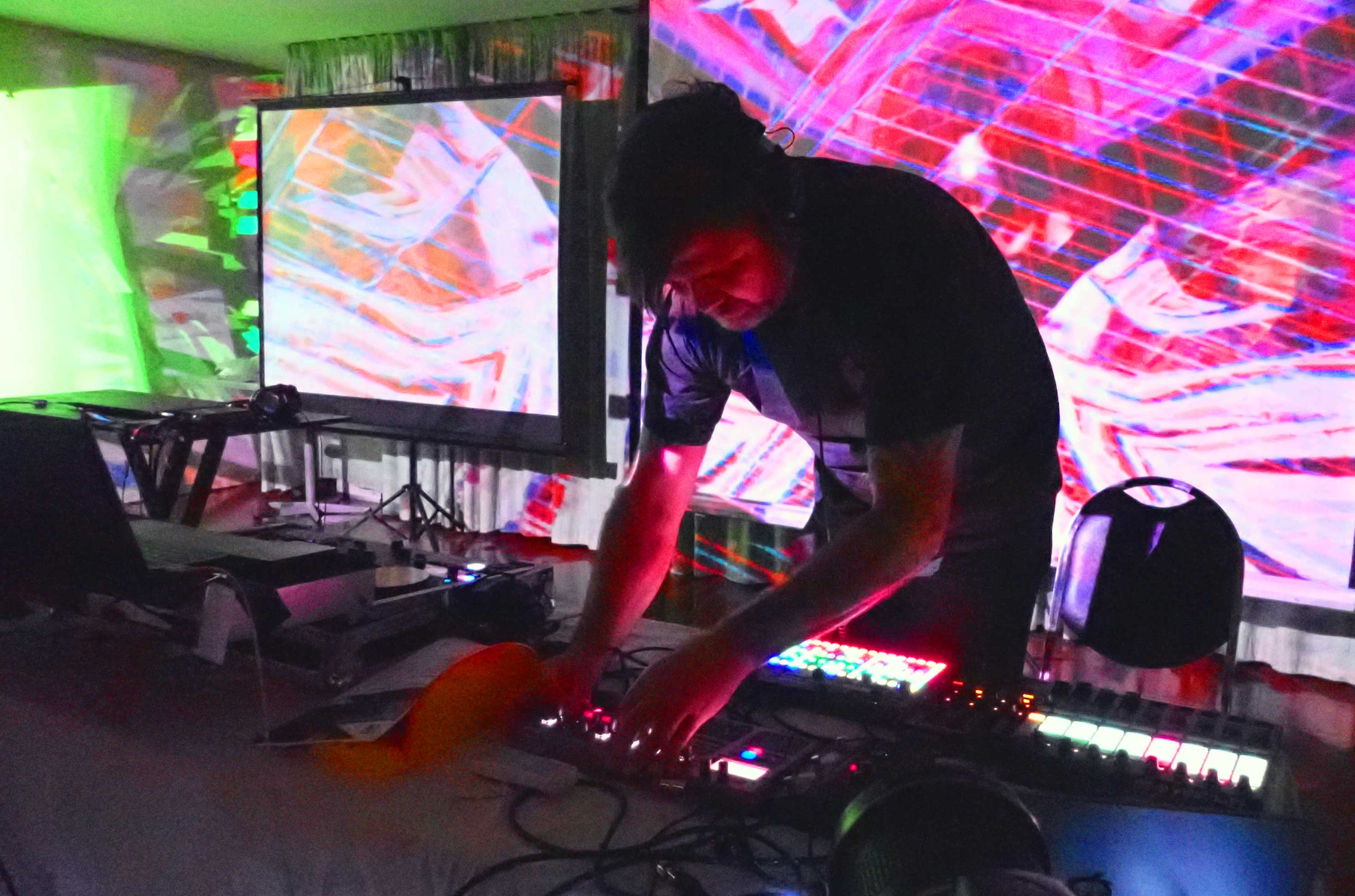
Bassling brought a collection of synthesisers onstage to accompany video projections and audio-activated visuals. (Photo by Bernard Gray)
Dron Skot's techno pummelled the sound system and brought a cheer from the Chinese restaurant next door.
(Thanks Lee and Donny!)
DJ Ruined My Wedding Day walked a fine line between giving the crowd the pop music they thought they knew, then perverting it into breakcore and rave.
Myst Mach's performance began with an audience singalong to 'Promiscuous' by Nelly Furtado, then channeled the spirit of Sophie with a DJ set accompanied with dancing and manipulated video that looked like it came from a fisting video.
The All Services Club provided a warm and friendly venue, as well as being enthusiastic in their support for the event.
The inFREQUENCY tour will bring together electronic musicians from the southeast and southwest for performances and workshops that showcase their different approaches
“We’re literally overcoming the Great Dividing Range to visit locations in regional New South Wales,” says organiser Jason Richardson.
“Our aim is to create opportunities to share cutting-edge audio-visual art through live shows and workshops that will provide a behind-the-scenes perspective on the techniques being used.”
There will be demonstrations of video projection-mapping and live-coding that provide an introduction to free software in workshops before the performances dazzle and inspire audiences.
Artists Scott Baker and Jason Richardson have two decades of experience in working together, including running projection-mapping workshops at Griffith Pioneer Park Museum in 2016.
Both were part of the Unsound Festivals that ran in Wagga Wagga, which put Australia’s experimental musicians on the world stage.
Baker has developed audio-visual art as Abre Ojos and his new techno persona Dron Skot, while Richardson’s work as Bassling has also gained national and international interest.
“This project began when I was enthusing to Scott how Bernard Gray was developing live-coding performance skills in Griffith with the DECODED workshops” says Jason.
“It brought to mind the skills in music-making and video-editing that I’d learned in Wagga, so we began planning a way to bring together this diverse group of musicians based in regional NSW.”
“Scott identified artists Myst Mach and The DJ Ruined My Wedding Day from the South Coast and we thought it’d be great to create performance opportunities to develop skills for the musicians and the audiences, because you never know where the ideas and experiences can take you.”
Myst Mach is a young producer and DJ from Tathra who pulls together genres far and wide to mould them into a kinetic object in their own dancefloor-focused journeys.
The DJ Ruined My Wedding Day will make you as giddy as a bride on their wedding day and build you up to only take you higher with their DJ set colliding old favourites with the best underground tunes.
Baker and Richardson reflect how the skills they’ve developed came from experiments with technology, performance and exhibition.
“It’s great to get out and perform, but it’s even better to aim to inspire the next generation of regional artists through the workshops we are running,” says Jason.
Red Earth Ecology is looking to commission four local artists for the "Leeton Memories" project, which will transform reminisces of older residents into shop front displays
"Our aim is to work with people to develop a series of displays based on interviews about observations of environmental change," says project coordinator Jason Richardson.
"We have a small budget to cover materials and contribute something toward the time of the four contributors."
Edited extracts from recorded interviews with longtime residents will prompt and inform a series of shop front installations and be linked to these displays using QR codes.
"The idea is that you'll be able to hear a recorded commentary from older residents and that will inform the experience for viewers seeing the artworks," says Jason.
"We hope people will think broadly about what materials can go into making a display and the budget should help to realise their ideas."
The Leeton Memories project will raise the profile of local art and also aims to help the artists involved to develop their own projects.
Each display will be promoted with a profile of the contributors and discussion about the themes raised in the interview.
"We will also share our CASP application for this project with the artists, so they can get an understanding of what goes into a successful funding proposal."
Afterwards Red Earth Ecology will consider assisting with grant applications from the artists for the development of future projects in our region where they relate to the aims of that organisation.
"Red Earth Ecology was incorporated to enable projects that link people to the landscape, whether through plant regeneration activities or cultural practices like making artworks," says Jason.
"There's also a need for pathways in the Riverina so artists can develop local projects and we're willing to provide guidance."
"We want this Leeton Memories project to be the start of something that will create new memories in Leeton for years to come."
Leeton Memories is supported by Western Riverina Arts and Create NSW through funding from the NSW Government.
Youtube's automation of copyright claims should be questioned
Look at what's happened to my video this morning.
A recording of my drumming, in fact two recordings of my drumming layered together, has been monetised by a company claiming I'm infringing on their copyright.
Someone else is collecting ad revenue from my material based on an automated response!
Youtube is facilitating this spurious claim and I think their system needs to be scrutinised.