It’d been our wedding anniversary and we’d been to dinner and a show in the city.
He’d drunk a little but thought we were alright to drive home. The car seemed to know though, and the long drive had been limited to 80 even though we rarely turn off the autopilot. I never learned to drive.
We weren’t too far out of town when Stan first heard the sound. He commented that the car needed maintenance, saying it could be the aircon or an engine fan. Usually our electric car is quiet but the sound continued to grow louder. A little later he said “I hope they’re not bikes.”
Then we could hear it was bikes. I suggested we make a report but Stan said it’s probably only drones and we’re too far from help anyway.
We knew the stories of bushrangers but they hadn’t been reported in our district before. We thought local farmers were too poor to be of interest to criminals.
Stan turned off the autopilot, trying to get our car to go faster. It was no good. The safety system would not allow us to speed up.
Their bikes were still getting louder but we weren’t too far from home now. We thought if we could get past the gate then they’d leave us alone.
Then we saw their lights behind us. There were nearly a dozen. Still the car wouldn’t change speed.
The bushrangers shot at our tyres and the car stopped. Stan tried to override the safety but the autopilot kept responding that maintenance was required. It shutdown.
They surrounded us. The lights on the motorbikes blinding us. I could see reflections off metal. They had weapons and armour. The smell of brewed fuel and dust came through our aircon.
After a little while they smashed the windscreen. I screamed.
Stan yelled that he’d give them whatever they wanted. They smashed his window and he fell forward.
I cried for help but still they revved their bikes. Stan wouldn’t move and I could see he was bleeding.
Then the back window was smashed and I heard them yell for my jewellery.
A hand came through Stan’s window and grabbed at my necklace. I threw out my bag and my earrings and brooch. They took Stan’s watch then rode away.
I bandaged Stan and called for help. It seemed to take over an hour for the medical drone to deliver supplies and the whole time I was afraid the bushrangers might return.

Em and en
One of things I enjoy about working in a museum is getting a sense of context for bits of otherwise trivial information that I've accumulated.
 An example is the difference between an em and an en. Shown here is a bronze en ruler that is in the collection at Griffith Pioneer Park Museum.
During other work editing documents and learning graphic design software, I was introduced to the differences between a hyphen, an en dash and an em dash.
A hyphen is like a minus sign except it adds words together to create a concept, like air-conditioner.
An en dash is the same size but shows a range, like 9-5 in Dolly Parton's song 'Nine to five' as shorthand for 9am to 5pm business hours.
An em dash is a longer dash and is used as a kind of dynamic in writing, like:
 Because I usually can't remember where to find the — on a keyboard, I'll write -- instead.
(On another matter, one thing that frustrates me is seeing people use an ellipsis instead of an em dash, as these should signify something is missing from a quotation. So, when I see an advertising slogan like "for the best prices in town... come to our shop," I assume they're saying there's a proviso like "for the best prices in town except the cheaper places that we won't mention...")
Anyway, the difference between en and em dashes these days is less important because digital design software has made a role like typesetter largely redundant. It's one of those professions that computers replaced a long time ago.
 Typesetters existed back in the day when printing plates were pieced together with individual letters. These days the process is mostly automated, so it's less important to know that an em represents the width of m, the widest letter; which is twice the width on n — although both and en and em are useful to know as two-letter words in Scrabble.
However, if you look in the settings of graphic design programs, you can still find evidence of ems as a measurement.
 Shown here is an instance in the preferences of Adobe's InDesign software.

During other work editing documents and learning graphic design software, I was introduced to the differences between a hyphen, an en dash and an em dash.
A hyphen is like a minus sign except it adds words together to create a concept, like air-conditioner.
An en dash is the same size but shows a range, like 9-5 in Dolly Parton's song 'Nine to five' as shorthand for 9am to 5pm business hours.
An em dash is a longer dash and is used as a kind of dynamic in writing, like:
“Familiarity breeds contempt — and children,” Mark Twain once said.

(On another matter, one thing that frustrates me is seeing people use an ellipsis instead of an em dash, as these should signify something is missing from a quotation. So, when I see an advertising slogan like "for the best prices in town... come to our shop," I assume they're saying there's a proviso like "for the best prices in town except the cheaper places that we won't mention...")
Anyway, the difference between en and em dashes these days is less important because digital design software has made a role like typesetter largely redundant. It's one of those professions that computers replaced a long time ago.

However, if you look in the settings of graphic design programs, you can still find evidence of ems as a measurement.


No Surprises
Reminds me how much I enjoyed watching HBO's Westworld over the Christmas break.
That show prompted many thoughts about the nature of being human and how we're going to struggle with artificial intelligence. I'm tempted to watch it again.
Louise Bourgeois
One of the main reasons I still log in to Twitter is Womens Art, which provides a steady stream of work by female artists.
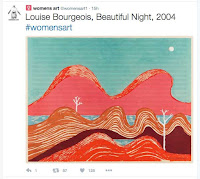 One of their perennial favourites is Louise Bourgeois, whose art I hadn't seen before and have been inspired to look for more.
I like the variety of art Bourgeois produced, including sculpture and installations, as well as the wry observation.
I also like how progressive she seems to have been. This might be a generalisation but it does seem like many male artists grow more conservative as they age, whereas there are many female artists that grow increasingly bold.
 Bourgeois battled against gender inequality in the arts and, at the age of 98 in 2010, donated an edition of 300 prints to raise money for marriage equality.
It seems interesting that this remains a battle in Australia, which has yet to satisfactorily resolve the debates and narrowly avoided going to an expensive plebiscite that was planned for next month.
The print "I do" symbolised Bourgeois' view of this issue:

I like the variety of art Bourgeois produced, including sculpture and installations, as well as the wry observation.
I also like how progressive she seems to have been. This might be a generalisation but it does seem like many male artists grow more conservative as they age, whereas there are many female artists that grow increasingly bold.

It seems interesting that this remains a battle in Australia, which has yet to satisfactorily resolve the debates and narrowly avoided going to an expensive plebiscite that was planned for next month.
The print "I do" symbolised Bourgeois' view of this issue:
"Everyone should have the right to marry," Bourgeois said in a release by Freedom to Marry. "To make a commitment to love someone forever is a beautiful thing."I also like this from the Wikipedia information on Bourgeois:
Bourgeois aligned herself with activists and became a member of the Fight Censorship Group, a feminist anti-censorship collective founded by fellow artist Anita Steckel. In the 1970s, the group defended the use of sexual imagery in artwork. Steckel argued, “If the erect penis is not wholesome enough to go into museums, it should not be considered wholesome enough to go into women.”Thanks Womens Art for introducing me to Louise Bourgeois' artwork.

Got a nice sunset pic?

I was moved to send a few of my pics to Kate after reading of her wish to see more than 14,000 sunsets before she loses her eyesight to Ushers syndrome.
Projection again


Projected in Wagga

Here's a short video of how it looks:


Scavengers
I've watched this three times now while showing it to various family members.
Without wanting to give anything away, I think the story is about our escapist tendencies. You've got two characters on an alien world performing strange feats, just so they can escape their reality for a moment. Reminds me of many activities.
Pine Trees against a Red Sky with Setting Sun
Hadn't seen this Vincent Van Gogh painting before today.
 'Pine Trees against a Red Sky with Setting Sun' was painted in November 1889, which surprises me as the colour looks like summer. It could even be a local setting with cypress pines on a dusty day during harvest, when the sky gets a bright yellow quality.
For many years I didn't understand the popularity of Van Gogh's art. Then I visited Chicago and stood in front of a few of his paintings at the Art Institute. Then I went back and stood there again. And then again, thanks to Grandma's membership. It's quite easy to get lost in those hypnotising brushstrokes.
There's something like a Japanese woodcut about this image too.

For many years I didn't understand the popularity of Van Gogh's art. Then I visited Chicago and stood in front of a few of his paintings at the Art Institute. Then I went back and stood there again. And then again, thanks to Grandma's membership. It's quite easy to get lost in those hypnotising brushstrokes.
There's something like a Japanese woodcut about this image too.
Devices versus people
A lot of people are sharing variations of this video where Simon Sinek discusses "Millenials."

Talking in generations, like "Millenials," always feels like a generalisation to me. So Sinek seems to make generalisations about generalisations. Or at least, that's how he's being represented.
I think there's merit in his identification of the addictive nature of digital devices and social media but wish it was framed in another conversation as it's relevant to a wider audience.

My response has been that a newspaper doesn't usually interrupt my conversation with a friend. I still find it rude to be talking with someone and have them answer a call without acknowledging that they're doing so.
I've written and spoken about 'digital capacity' but maybe it's time to think in terms of 'digital incapacity'?
Another friend recently returned to social media after taking a fortnight break over Christmas. He wrote about the experience as a "reset," which seems like a good approach to dealing with a potentially addictive behaviour.

Subscribe to:
Posts (Atom)