I've observed that Google's generated news service sometimes goes wrong, like this satire last year that was promoted as actual news.
This morning I noticed the site was promoting as news a sponsored piece for a gambling app.
I think this is significant as many jobs have been lost in media organisations to "cost-cutting" and many more will be lost as artificial intelligence compiles news reports from available data. With it will go editorial judgment and audiences will lose respect for the content as quality suffers.
50 videos
Just noticed that this weekend I've reached the milestone of producing my 50th video as a result of Disquiet Junto projects.
I've lost track of how many tracks I've produced, but at last count it was over 120 recordings. There's a bit about how much I love the Juntos -- and why -- here.
Jailbait clickbait
Looking at Google News this morning and I was confronted with an image I thought was risque, only to click-through and find it was more tasteful than I'd thought.
Feel like I've got a dirty mind now.
Reflecting light
The piece below is the third and final piece in a series prompted by ABC Open. (Here are the first and second parts.)
It picks up on an earlier post here because I liked the idea of shifting focus from the physical landscape to an emotional one, in part for the idea from the road movie genre of using travel as a metaphor for personal change; mostly as I'm seeing so much anxiety among friends at the moment. It's been fascinating to have the observation of my own state reaffirmed by those around me.
Anyway, here's the piece:
The days have started to shorten but the bite hasn’t softened in the sunshine.
As the sun lowers to the north and rises later, I can see the shadow of my car stretch out in front at times as I drive from Leeton to Griffith. Last week the light was at an angle that revealed a police car tucked away in the boree wattle by the side of the road. The red and blue of their slim rooftop lights twinkled from about a kilometre away.
In paddocks by the side of the road I see corn drying on stalks, as well as rice looking lush green, and lots of oranges on trees. The wine grapes have been picked early this year, and early in the day too. On those mornings there was a trail of grape leaves scattered along the road leading to the wineries like a bread crumb trail from a fairy tale.
My partner lamented last week how summer used to build to blazing heat, but now the cooking starts on the long weekend in October and eases around Easter. I hope she’s right as Easter is early this year.
As the light changes I notice internal changes. There’s an increased feeling of anxiousness. I start spending more time on shopping websites and remind myself that I observed this trend toward compulsive spending last year. I tell myself that I don’t really need another synthesiser that will accumulate dust under my bed.
It really is bizarre how the rituals transplanted from the northern hemisphere are inverted in the south. We antipodeans celebrate the resurrection of our son god as the sun diminishes. The winter solstice lacks the festivity of Christmas, a time when gathering and expressing good will would be a benefit. I realise my partners’ family must’ve come to this conclusion long ago, as I remember their annual winter bonfire and the friends who I often only see on that night each year.
I want to share these observations with friends on Facebook but reconsider. There are studies that suggest our emphatic natures will see people reflect on my feelings of morbidity and mild stress with their own.
And so, as I start reflecting on how disconnected I feel from the seasons, I also start to feel disconnected from many of my people. It’s further reminder of the physical distances between us and the way that, over the years, our lives have grown in different directions.
Then, as if to pinch myself, I remember the term seasonal attitude disorder. It’s cute the way the acronym encapsulates a sense of its effect. I also think of that term I’m seeing more often among my friends with a New Age bent, and that’s ‘light worker’.
Clearly I need to focus on bringing my own light into these looming shadows or winter will be a drag. In the meantime I remind myself to be grateful to see light twinkle back at me from the eyes of my partner and children. The time I have with them is passing with the seasons and it’s wonderful to see them grow.
It picks up on an earlier post here because I liked the idea of shifting focus from the physical landscape to an emotional one, in part for the idea from the road movie genre of using travel as a metaphor for personal change; mostly as I'm seeing so much anxiety among friends at the moment. It's been fascinating to have the observation of my own state reaffirmed by those around me.
Anyway, here's the piece:
The days have started to shorten but the bite hasn’t softened in the sunshine.
As the sun lowers to the north and rises later, I can see the shadow of my car stretch out in front at times as I drive from Leeton to Griffith. Last week the light was at an angle that revealed a police car tucked away in the boree wattle by the side of the road. The red and blue of their slim rooftop lights twinkled from about a kilometre away.
In paddocks by the side of the road I see corn drying on stalks, as well as rice looking lush green, and lots of oranges on trees. The wine grapes have been picked early this year, and early in the day too. On those mornings there was a trail of grape leaves scattered along the road leading to the wineries like a bread crumb trail from a fairy tale.
My partner lamented last week how summer used to build to blazing heat, but now the cooking starts on the long weekend in October and eases around Easter. I hope she’s right as Easter is early this year.
As the light changes I notice internal changes. There’s an increased feeling of anxiousness. I start spending more time on shopping websites and remind myself that I observed this trend toward compulsive spending last year. I tell myself that I don’t really need another synthesiser that will accumulate dust under my bed.
It really is bizarre how the rituals transplanted from the northern hemisphere are inverted in the south. We antipodeans celebrate the resurrection of our son god as the sun diminishes. The winter solstice lacks the festivity of Christmas, a time when gathering and expressing good will would be a benefit. I realise my partners’ family must’ve come to this conclusion long ago, as I remember their annual winter bonfire and the friends who I often only see on that night each year.
I want to share these observations with friends on Facebook but reconsider. There are studies that suggest our emphatic natures will see people reflect on my feelings of morbidity and mild stress with their own.
And so, as I start reflecting on how disconnected I feel from the seasons, I also start to feel disconnected from many of my people. It’s further reminder of the physical distances between us and the way that, over the years, our lives have grown in different directions.
Then, as if to pinch myself, I remember the term seasonal attitude disorder. It’s cute the way the acronym encapsulates a sense of its effect. I also think of that term I’m seeing more often among my friends with a New Age bent, and that’s ‘light worker’.
Clearly I need to focus on bringing my own light into these looming shadows or winter will be a drag. In the meantime I remind myself to be grateful to see light twinkle back at me from the eyes of my partner and children. The time I have with them is passing with the seasons and it’s wonderful to see them grow.
Commercial coffees I have enjoyed
Since I bought an Aeropress, I've really enjoyed sampling different blends of coffee. Here are a few of my current favourites.
Lavazza Caffe Torino has a nice dark cocoa taste. I've found it's great when brewed with water around 65-80C. There's less bitterness and a big rich chocolate-y body, which is a characteristic of all three Lavazza blends. The others have more of a roast-y flavour and they all go a long way. I find you can get away with using less, maybe three-quarters of what other brands require.
These two Vittoria blends aren't tied for second place. In fact, I find them a bit ordinary on their own. When you put them together though, there's a complementary flavour that emerges. The Mountain Grown brings body, while the pissweak Organic flavour fills in around it. I also like the regular Vittoria and find it benefits from hot, almost boiling water to bring out depth.
Caffe Aurora Italian Blend is really distinctive as it tastes burnt. When I share it with people their response is usually "Yuck!" but the charcoal flavour works for me. It softens the bitterness to the point of making it like a cup of milky Milo. I don't like the competition promoted on the bag though, as the stickers were blank when I turned them over so it annoyed me that I couldn't enter to win $10,000 since I've bought three bags now.
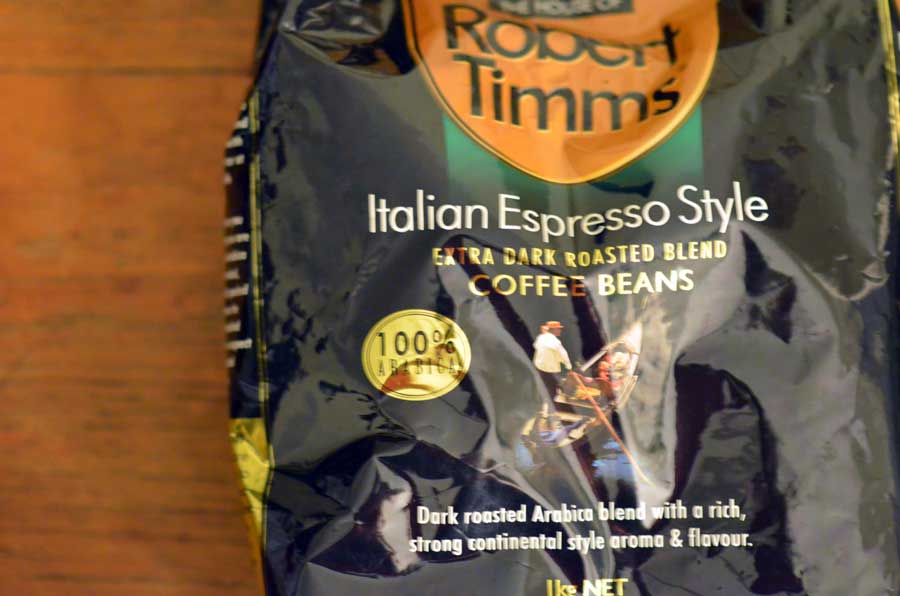
Robert Timms Italian Espresso Style has a dark body that's not very rich. It also has a bitterness that's more akin to the regular Vittoria but darker, even when brewed at lower temperatures. There's an acidity too that's quite distinct. The other thing I like is that it reminds me of when I first started drinking their coffee bags in the 1990s and discovered how much smoother brewed coffee was to instant.
Lavazza Caffe Torino has a nice dark cocoa taste. I've found it's great when brewed with water around 65-80C. There's less bitterness and a big rich chocolate-y body, which is a characteristic of all three Lavazza blends. The others have more of a roast-y flavour and they all go a long way. I find you can get away with using less, maybe three-quarters of what other brands require.
These two Vittoria blends aren't tied for second place. In fact, I find them a bit ordinary on their own. When you put them together though, there's a complementary flavour that emerges. The Mountain Grown brings body, while the pissweak Organic flavour fills in around it. I also like the regular Vittoria and find it benefits from hot, almost boiling water to bring out depth.
Caffe Aurora Italian Blend is really distinctive as it tastes burnt. When I share it with people their response is usually "Yuck!" but the charcoal flavour works for me. It softens the bitterness to the point of making it like a cup of milky Milo. I don't like the competition promoted on the bag though, as the stickers were blank when I turned them over so it annoyed me that I couldn't enter to win $10,000 since I've bought three bags now.
Robert Timms Italian Espresso Style has a dark body that's not very rich. It also has a bitterness that's more akin to the regular Vittoria but darker, even when brewed at lower temperatures. There's an acidity too that's quite distinct. The other thing I like is that it reminds me of when I first started drinking their coffee bags in the 1990s and discovered how much smoother brewed coffee was to instant.
Labels:
random review
(fe)manifesto
My partner produced this interactive artwork for the Reconstructing exhibition that's currently at the HR Gallop Gallery at Charles Sturt University's Wagga Wagga Campus.
Visitors are invited to glue on lines from a famous feminist texts, using the cut-up method to create a manifesto.
Labels:
cut-up
Full moon over Leeton Rice Co-op
The Rice Co-op hums all-day almost all-year at the end of my street.
If you listen carefully you might hear the hum as part of my soundtrack for Reimagining The Murrumbidgee from a few years ago, but I also just recorded it for a Junto too.
It's lit-up at night and I enjoy photographing it, like this shot from last year when I was thinking how I'd interpret the WRA photo competition theme 'Living Leeton' that I couldn't enter as an employee.
The full moon this week prompted me to take more photos, like this one. As I was looking back over them I thought how much I like the red dot of the 'No Entry' sign in this one, since the design of that building in the background often prompts me to think on Japanese influence in the local rice industry. The first experimental rice crop here started with the arrival of grain from Isaburo Takasuka, which came via his nephew's motorcycle in the early 20th Century.
These days Leeton is home to the SunRice brand, who sponsor a festival every other year and I recently tried to add a multicultural event to their program as a way of raising the role of this grain in the diet of people all over the world. Funding was unsuccessful, so maybe another year.
And the 'No entry' sign also reminds me of Japan's isolationist history, which is mentioned in this beaut video by Bill Wurtz.
If you listen carefully you might hear the hum as part of my soundtrack for Reimagining The Murrumbidgee from a few years ago, but I also just recorded it for a Junto too.
It's lit-up at night and I enjoy photographing it, like this shot from last year when I was thinking how I'd interpret the WRA photo competition theme 'Living Leeton' that I couldn't enter as an employee.
The full moon this week prompted me to take more photos, like this one. As I was looking back over them I thought how much I like the red dot of the 'No Entry' sign in this one, since the design of that building in the background often prompts me to think on Japanese influence in the local rice industry. The first experimental rice crop here started with the arrival of grain from Isaburo Takasuka, which came via his nephew's motorcycle in the early 20th Century.
These days Leeton is home to the SunRice brand, who sponsor a festival every other year and I recently tried to add a multicultural event to their program as a way of raising the role of this grain in the diet of people all over the world. Funding was unsuccessful, so maybe another year.
And the 'No entry' sign also reminds me of Japan's isolationist history, which is mentioned in this beaut video by Bill Wurtz.
Labels:
photography,
video
Young praying mantis on tansy
Originally posted one of these pics on my wildlife blog, then thought I'd go back and look over them again.
Labels:
my other blogs,
photography
Dying a little
Last year I noticed a growing anxiety at this time of the year and, now that I've awoken from anxious dreams, I'm wondering if it isn't to do with the shortening days. Wondering if I'm that disconnected from the changing of the seasons that I've never recognised their effect before.
With spring it's an obvious sense of life unfurling, whereas autumn is a slower process of death and decay. The leaves gradually change colour -- and that's only the imported trees, those deciduous ones that are part of a human-built environment in Australia.
Last year I was very aware of death as I spent Easter thinking about a dead woman. It was the first time I'd really pondered death at that time of the year, which is another sign of my disconnectedness. Being an atheist means not thinking too much about the symbolism of Easter, yet here was an event that prompted me to think on it.
I started to wonder about the significance of Stephanie's death and saw a myriad of ways that people were reflecting on it, from putting yellow around the town or hanging out their wedding dresses. It suddenly brought a morbid focus to a lot of things.
Today it was explained to me why Easter changes date each year. I could see that anchoring it to the full moon after the equinox makes it a seasonal event. and that it is an ideal time for camping as the last glow of summer fades. Camping seems like a good idea too as it would take me away from the usual distractions like Facebook that generally only amplify whatever mood I share with friends.
Those studies that suggest that people feel depressed when they see friends feeling depressed suggest that I shouldn't start reflecting on my morbid mood on Facebook. Yet I'm aware that there is a gap in my life for something that reaffirms life at this time of the year.
With spring it's an obvious sense of life unfurling, whereas autumn is a slower process of death and decay. The leaves gradually change colour -- and that's only the imported trees, those deciduous ones that are part of a human-built environment in Australia.
Last year I was very aware of death as I spent Easter thinking about a dead woman. It was the first time I'd really pondered death at that time of the year, which is another sign of my disconnectedness. Being an atheist means not thinking too much about the symbolism of Easter, yet here was an event that prompted me to think on it.
I started to wonder about the significance of Stephanie's death and saw a myriad of ways that people were reflecting on it, from putting yellow around the town or hanging out their wedding dresses. It suddenly brought a morbid focus to a lot of things.
Today it was explained to me why Easter changes date each year. I could see that anchoring it to the full moon after the equinox makes it a seasonal event. and that it is an ideal time for camping as the last glow of summer fades. Camping seems like a good idea too as it would take me away from the usual distractions like Facebook that generally only amplify whatever mood I share with friends.
Those studies that suggest that people feel depressed when they see friends feeling depressed suggest that I shouldn't start reflecting on my morbid mood on Facebook. Yet I'm aware that there is a gap in my life for something that reaffirms life at this time of the year.
Field recorded and remixed
Above is a field recording made last week outside Wagga Wagga, and below is how it sounds remixed into a short house-style track.
Labels:
ambience,
compare/contrast,
my music,
video
Hairy panic
Hairy panic is an Australian tumbleweed and it's in the news at present for inundating Wangaratta.
The news story in the link above says it's not a fire risk but I've found it's great for starting fires because it burns like petrol.
Hairy panic seems like a funny name until you experience it caught in your pants. Then it feels like something crawling up your leg.
This photo was taken in 2008, when there was a massive build-up of the dried weed at the property where I was living outside Wagga. You can see it totally obscures me.
I wrote these lyrics for a song at that time and I think I should finally get to recording it because there were chords too.
I'm a tumbling weed
my life is floating on the breeze
no choice but let the wind blow
and determine where I go
Rolling on the ground
I creep without making a sound
shake a spindly arm
and catch my seed in your palm
(Prechorus)
With a breath on the breeze
I inhale and it frees
Caught pushed against a wall
I'll erupt and then I'll fall
taking opportunity
wherever the wind is moving me
You'll never know what I've faced
to reach this resting place
when the summer has come and gone
my kind will roll along
(Prechorus)
(Chorus)
Accept the change, weather the rains
and live to roll another day
Wherever I go, the grass will grow
and I live to roll another day
The news story in the link above says it's not a fire risk but I've found it's great for starting fires because it burns like petrol.
Hairy panic seems like a funny name until you experience it caught in your pants. Then it feels like something crawling up your leg.
This photo was taken in 2008, when there was a massive build-up of the dried weed at the property where I was living outside Wagga. You can see it totally obscures me.
I wrote these lyrics for a song at that time and I think I should finally get to recording it because there were chords too.
I'm a tumbling weed
my life is floating on the breeze
no choice but let the wind blow
and determine where I go
Rolling on the ground
I creep without making a sound
shake a spindly arm
and catch my seed in your palm
(Prechorus)
With a breath on the breeze
I inhale and it frees
Caught pushed against a wall
I'll erupt and then I'll fall
taking opportunity
wherever the wind is moving me
You'll never know what I've faced
to reach this resting place
when the summer has come and gone
my kind will roll along
(Prechorus)
(Chorus)
Accept the change, weather the rains
and live to roll another day
Wherever I go, the grass will grow
and I live to roll another day
Labels:
lyrics
Projection idea
The projection workshop in Wagga last weekend forced me to rethink my ideas.
Previously I'd thought projection was just video made big but I've come to see it's a different medium.
One of the ideas I experimented with involved using the clear blue sky like a green screen to cut out bees and trees, which were then colourised for psychedelic effect.
The bees ended up in my Junto video this week, while the trees were tested on half the projection space along the length of Wagga's council building.
Tutor Yandell took this pic for me, which looks more impressive than the video -- which is a very rough sketch.
Previously I'd thought projection was just video made big but I've come to see it's a different medium.
One of the ideas I experimented with involved using the clear blue sky like a green screen to cut out bees and trees, which were then colourised for psychedelic effect.
The bees ended up in my Junto video this week, while the trees were tested on half the projection space along the length of Wagga's council building.
Tutor Yandell took this pic for me, which looks more impressive than the video -- which is a very rough sketch.
Kurrajong magic
Kurrajong trees seem kinda unusual in the Australian landscape.
Their glossy green leaves stand out against the dull blue-grey of gums and their wood seems somewhat porous. I'd guess it allows them to store enough water to survive summer, especially as they lose their leaves every other year -- unlike gums, which aren't deciduous.
They also have these seedpods that are itchy and the trees only seem to grow from granite, which they cover with a rich soil as their leaves fall and deteriorate. And they grow very slowly, so the very old ones predate European settlement.
This stand of kurrajongs outside Wagga always seems magic to me. I like to imagine that they form a portal of some sort, as it reminds me of a scene I saw from a film in an anthropology class about rites of passage. In the film a couple split a tree in half and passed their son through it to celebrate a birthday and mark a passage into a new stage of his life.
Their glossy green leaves stand out against the dull blue-grey of gums and their wood seems somewhat porous. I'd guess it allows them to store enough water to survive summer, especially as they lose their leaves every other year -- unlike gums, which aren't deciduous.
They also have these seedpods that are itchy and the trees only seem to grow from granite, which they cover with a rich soil as their leaves fall and deteriorate. And they grow very slowly, so the very old ones predate European settlement.
This stand of kurrajongs outside Wagga always seems magic to me. I like to imagine that they form a portal of some sort, as it reminds me of a scene I saw from a film in an anthropology class about rites of passage. In the film a couple split a tree in half and passed their son through it to celebrate a birthday and mark a passage into a new stage of his life.
Projection workshop
Emergency, 2008. Beyond the Window, Bus Gallery. from Yandell Walton on Vimeo.
This week I've been attending a workshop with Yandell Walton organised by Wagga Wagga City Council.
It's been really inspiring to meet a diverse cohort interested in projection, as each bring their own aesthetic and experience. I've also been inspired by Walton's open and supportive approach to workshops, particularly the opportunity to read her masters thesis and be better informed about her work. Often visiting artists can be unwilling to share their skills but she has shown us many aspects of her practice, from the technical to the administrative.
I'm also really taken with the work above, Emergency (2008). It's a collaboration with photographer Clare Hassett that illustrates Walton's interest in death and also updates the style of William H. Mumler.
Eucalypt regrowth
Hard to kill Australian natives, like this Eucalyptus blakelyi, also known as the Blakely's Red Gum.
You find many in the Riverina that were ring-barked around 150 years ago, yet have regrown since.
In some ways I think the endurance of eucalypts in this way is a good metaphor for the resurgence of indigenous Australians.
You find many in the Riverina that were ring-barked around 150 years ago, yet have regrown since.
In some ways I think the endurance of eucalypts in this way is a good metaphor for the resurgence of indigenous Australians.
Labels:
comment
Peckish no salt rice crackers
It's great to see that salt-free rice crackers are now available and, even better, they're from a brand who make nice biscuits too.
Rice crackers are a product that fascinate me. There are so many brands in the supermarket and, largely, they all vary in their texture as well as flavours. I don't know how these things are processed and cooked but it's clear that there are differences. At one end of the spectrum is the fluffy and somewhat sweet crackers made by Fantastic and, at the other end, is the brittle and sorta solid Vita-weat.
Peckish, who make the packet shown above, are closer to Sakata in their texture but additives like rice bran oil really distinguish them.
If Peckish are reading, let me reiterate how great I think it'd be to see a range of curry-flavoured crackers. I'm surprised no one has done this yet, given how excellent it would be to have a tomato-based vindaloo or madras with a hint of cardamon or coconut milk-infused korma or even a sweet butter chicken flavour. Or maybe actual fennel seeds in a rogan josh flavoured cracker. Or how about a papadum-style with chick peas? Or samosa flavour with tamarind like the dipping sauce?
There are soooo many options -- make it happen!
Rice crackers are a product that fascinate me. There are so many brands in the supermarket and, largely, they all vary in their texture as well as flavours. I don't know how these things are processed and cooked but it's clear that there are differences. At one end of the spectrum is the fluffy and somewhat sweet crackers made by Fantastic and, at the other end, is the brittle and sorta solid Vita-weat.
Peckish, who make the packet shown above, are closer to Sakata in their texture but additives like rice bran oil really distinguish them.
If Peckish are reading, let me reiterate how great I think it'd be to see a range of curry-flavoured crackers. I'm surprised no one has done this yet, given how excellent it would be to have a tomato-based vindaloo or madras with a hint of cardamon or coconut milk-infused korma or even a sweet butter chicken flavour. Or maybe actual fennel seeds in a rogan josh flavoured cracker. Or how about a papadum-style with chick peas? Or samosa flavour with tamarind like the dipping sauce?
There are soooo many options -- make it happen!
Labels:
random review
Sketchy sketch
Had a quiet chuckle when I saw this so-called sketch as it's clear someone has used the 'find edges' filter in Photoshop on the photo of the sculpture on the opposite page. Just look at the line that remains over the left shoulder.
Hi stories
There are a few projects taking shape at work that suggest histories I need to research.
The first is learning about the varieties of late 19th Century horse carts and technologies that appear, such as pneumatic tyres. There's a display that's required to make sense of a collection of sulkies and buggies. I'll need to oversee the restoration of a some but it's little details like this foot-operated bell that are capturing my attention. Was it fitted to the buggy after sale?
Another area that I'm being directed to explore is the tractors distributed in Australia by International Harvester. Pioneer Park Museum has recently been given a working T20 tractor, which is distinctive for the use of caterpillar tracks rather than oversized wheels. It would've been built in the mid-1930s and it was while looking at two others we have that I noticed this plate on an older tractor that I think was inspired by Clayton and Shuttleworth or Aveling and Porter.
It's surprising to see the leather belts on the older tractor are still intact, given it's displayed in the open air.
The final direction is to learn more about Warangesda Mission, which was started at Darlington Point in 1880 and marked a change in the treatment of indigenous Australians. Many of the remaining local Wiradjuri people have connections to this institution, which sought to protect Aborigines from exploitation by white Australians. While it was founded on Christian values, it's difficult not to see the beginning of the paternal attitude that led to the Stolen Generation.
I was surprised to find the font bowl from the Mission is on display in St James Church, which was moved from Hanwood to the Museum in the 1970s. The Church isn't open to the public, so it'd be good to put this somewhere where it can be seen by visitors. Warangesda was mentioned by the younger Stan Grant recently.
The first is learning about the varieties of late 19th Century horse carts and technologies that appear, such as pneumatic tyres. There's a display that's required to make sense of a collection of sulkies and buggies. I'll need to oversee the restoration of a some but it's little details like this foot-operated bell that are capturing my attention. Was it fitted to the buggy after sale?
Another area that I'm being directed to explore is the tractors distributed in Australia by International Harvester. Pioneer Park Museum has recently been given a working T20 tractor, which is distinctive for the use of caterpillar tracks rather than oversized wheels. It would've been built in the mid-1930s and it was while looking at two others we have that I noticed this plate on an older tractor that I think was inspired by Clayton and Shuttleworth or Aveling and Porter.
It's surprising to see the leather belts on the older tractor are still intact, given it's displayed in the open air.
The final direction is to learn more about Warangesda Mission, which was started at Darlington Point in 1880 and marked a change in the treatment of indigenous Australians. Many of the remaining local Wiradjuri people have connections to this institution, which sought to protect Aborigines from exploitation by white Australians. While it was founded on Christian values, it's difficult not to see the beginning of the paternal attitude that led to the Stolen Generation.
I was surprised to find the font bowl from the Mission is on display in St James Church, which was moved from Hanwood to the Museum in the 1970s. The Church isn't open to the public, so it'd be good to put this somewhere where it can be seen by visitors. Warangesda was mentioned by the younger Stan Grant recently.
Labels:
Pioneer Park
Yay for Australia Day
Regular readers may recognise the sarcasm in the title above. I am patriotic about being Australian but it's a love like that of a parent who is not reluctant to chide their child. We need to find another date to acknowledge a common day of celebration.
The solution to finding a day to celebrate Australia through a national public holiday can be solved by becoming a republic. Then we can celebrate the day that came to be.
Labels:
nationalistic bullshit
Growing old
When I ride into town I go over the train tracks outside the Rice Coop. There are two sets of tracks and often I’ll lift the front wheel or, if I’ve got enough speed, attempt to bunny-hop over.
Yesterday I was riding home and the wind wasn’t in my favour, so I only popped the front. A car passed between the first and second tracks and I distinctly heard a woman’s voice say "Grow up!"
It prompts me to reflect on how few parents I see joining their kids in the public pool or on playgrounds. They're missing out.
Yesterday I was riding home and the wind wasn’t in my favour, so I only popped the front. A car passed between the first and second tracks and I distinctly heard a woman’s voice say "Grow up!"
It prompts me to reflect on how few parents I see joining their kids in the public pool or on playgrounds. They're missing out.
Labels:
comment,
life skill,
parenting
Return to Scenic Hill
The novelty of the New Year wears off soon after returning to work. As I resume commuting from Leeton to Griffith, I’m reminded that it was immediately after the school holidays that I most felt like wagging.
The drive up Scenic Hill toward Pioneer Park Museum isn’t as blinding as it was a couple of months ago. The angle of the sun has changed so it no longer shines directly through the windscreen. As I park the car I can smell the chlorine evaporating from the water being sprinkled on the beautiful gardens. Local birds seem to know when the sprinklers are due to start. Apostle Birds and Grass Parrots can be seen showering outside the Italian Museum in the morning.
Last week when the temperature rose above 45 degrees there were many birds around the water tanks. Crested Pigeons were hanging around the tank by the working windmill, while next to ‘Fairview’ Cottage I saw a couple of Pardalotes diving into another tank. Up the hill were a mob of thirsty-looking Black Jays.
While 45 isn’t the hottest day Griffith has seen — a record 46 in 2001! — it’s a new experience for me. I still remember when it first got above 40 after moving to Wagga Wagga about a decade ago. Since moving to the Riverina it now doesn’t feel warm enough to swim until it gets to 30 degrees. Even then, if you’re swimming in the Murrumbidgee, it can still feel cool. Despite spending more than a week travelling down from the nearest dams, the ‘big waters’ of the ‘Bidgee feel like snowmelt until the creeks and channels allow the sunlight to better penetrate the murk as it flows into the MIA.
The landscape has paled under the summer sun but it doesn’t look like it’ll get to the point where it’s varying shades of beige, as it was during the drought last decade. The rain in the Western Riverina has been regular enough to ensure there are cracks of green weeds along the edges of paddocks and roads.
There are signs of optimism among farmers, if I’m not mistaken. The plumes of smoke seem to indicate preparations for the sowing of summer crops. While passing a blackened paddock last week I observed one farmer watering the power pole on the edge of his land while fires remove debris. It’s entertaining to think that he’s growing electrical infrastructure.
It’s not just smoke that means the dry air on the summer wind has lost the fragrant scents of spring. As the weather warms, the road melts and becomes shiny and smells like fresh bitumen. Hot wind has an effect of stealing my breath, a sensation that makes me wonder if this is how a vacuum would smell?
On the really hot mornings Cicadas make their shrill music from the trees. As I drive past there’s a Doppler effect as the screech reluctantly seems to pitch down, as though grasping to keep ahold of my ears. They are deafening in places, like down by the Murrumbidgee River or near the Peppermint Gums up the road from my house.
Cicadas are also among the Cyprus Pines at Pioneer Park, particularly behind the Irrigation Museum. That’s the spot where a feral Olive tree has grown under a big Grey Box. There are lots of olives growing in the Riverina and I think it’s a beaut analogy for the way other exports from the Mediterranean have thrived in the region.
Near the turn to Griffith there’s an old tractor outside a vineyard. For years it had a For Sale sign but now it seems to have blown away. I’m entertained to see this leads to a slew of photographs on Instagram as new arrivals of backpacker fruit-pickers seem to decide it’s a landmark or possibly public art.
A dead kangaroo near the railway crossing at Widgelli decomposes over the last fortnight. It goes from being bloated like a stuffed toy to being red raw and to being a flattened rug. Last week I disturbed winged scavengers, ranging from flies to a massive Wedge-tailed Eagle. It’s a contrast to the dead tortoise near the railway crossing on the Whitton Stock Route Road, whose shell remains as an outline on the dog-leg-like bend in the road under a sheen of rubber left by the tyres of turning trucks.
A little further along and there’s the Madonna of Mirrool Creek. She looks somewhat Italian, so she may be a resident of Griffith — where around half the population are from Italy or their parents were. She seems to be peering around a wattle and smiling toward someone in the scrub away from the road. It isn’t until you’re close enough to see a sparkle in her eyes and the red in her glass that one can read the text accompanying her on the billboard and learn that one in four glasses of Australian wine is produced in this region.
On the hot days before a change in the weather, I see the smoke rising in the distance as I drive down from Scenic Hill. There’s a mild but intent focus that follows. I can rationalise that it’s a paddock being cleared but the element of fire is a risk. One that is limited by the extensive clearing of the highly-flammable Cyprus Pine undertaken by earlier settlers like Alfred Hill in the late 19th Century. It was these straight trunks that he used to build ‘Fairview’ Cottage and the name is a description of the landscape he saw as he surveyed a fair view of the work before him.
As I survey Scenic Hill I see thickets of Cyprus Pine and then look at the smoking paddocks on the way home.
The drive up Scenic Hill toward Pioneer Park Museum isn’t as blinding as it was a couple of months ago. The angle of the sun has changed so it no longer shines directly through the windscreen. As I park the car I can smell the chlorine evaporating from the water being sprinkled on the beautiful gardens. Local birds seem to know when the sprinklers are due to start. Apostle Birds and Grass Parrots can be seen showering outside the Italian Museum in the morning.
Last week when the temperature rose above 45 degrees there were many birds around the water tanks. Crested Pigeons were hanging around the tank by the working windmill, while next to ‘Fairview’ Cottage I saw a couple of Pardalotes diving into another tank. Up the hill were a mob of thirsty-looking Black Jays.
While 45 isn’t the hottest day Griffith has seen — a record 46 in 2001! — it’s a new experience for me. I still remember when it first got above 40 after moving to Wagga Wagga about a decade ago. Since moving to the Riverina it now doesn’t feel warm enough to swim until it gets to 30 degrees. Even then, if you’re swimming in the Murrumbidgee, it can still feel cool. Despite spending more than a week travelling down from the nearest dams, the ‘big waters’ of the ‘Bidgee feel like snowmelt until the creeks and channels allow the sunlight to better penetrate the murk as it flows into the MIA.
The landscape has paled under the summer sun but it doesn’t look like it’ll get to the point where it’s varying shades of beige, as it was during the drought last decade. The rain in the Western Riverina has been regular enough to ensure there are cracks of green weeds along the edges of paddocks and roads.
There are signs of optimism among farmers, if I’m not mistaken. The plumes of smoke seem to indicate preparations for the sowing of summer crops. While passing a blackened paddock last week I observed one farmer watering the power pole on the edge of his land while fires remove debris. It’s entertaining to think that he’s growing electrical infrastructure.
It’s not just smoke that means the dry air on the summer wind has lost the fragrant scents of spring. As the weather warms, the road melts and becomes shiny and smells like fresh bitumen. Hot wind has an effect of stealing my breath, a sensation that makes me wonder if this is how a vacuum would smell?
On the really hot mornings Cicadas make their shrill music from the trees. As I drive past there’s a Doppler effect as the screech reluctantly seems to pitch down, as though grasping to keep ahold of my ears. They are deafening in places, like down by the Murrumbidgee River or near the Peppermint Gums up the road from my house.
Cicadas are also among the Cyprus Pines at Pioneer Park, particularly behind the Irrigation Museum. That’s the spot where a feral Olive tree has grown under a big Grey Box. There are lots of olives growing in the Riverina and I think it’s a beaut analogy for the way other exports from the Mediterranean have thrived in the region.
Near the turn to Griffith there’s an old tractor outside a vineyard. For years it had a For Sale sign but now it seems to have blown away. I’m entertained to see this leads to a slew of photographs on Instagram as new arrivals of backpacker fruit-pickers seem to decide it’s a landmark or possibly public art.
A dead kangaroo near the railway crossing at Widgelli decomposes over the last fortnight. It goes from being bloated like a stuffed toy to being red raw and to being a flattened rug. Last week I disturbed winged scavengers, ranging from flies to a massive Wedge-tailed Eagle. It’s a contrast to the dead tortoise near the railway crossing on the Whitton Stock Route Road, whose shell remains as an outline on the dog-leg-like bend in the road under a sheen of rubber left by the tyres of turning trucks.
A little further along and there’s the Madonna of Mirrool Creek. She looks somewhat Italian, so she may be a resident of Griffith — where around half the population are from Italy or their parents were. She seems to be peering around a wattle and smiling toward someone in the scrub away from the road. It isn’t until you’re close enough to see a sparkle in her eyes and the red in her glass that one can read the text accompanying her on the billboard and learn that one in four glasses of Australian wine is produced in this region.
On the hot days before a change in the weather, I see the smoke rising in the distance as I drive down from Scenic Hill. There’s a mild but intent focus that follows. I can rationalise that it’s a paddock being cleared but the element of fire is a risk. One that is limited by the extensive clearing of the highly-flammable Cyprus Pine undertaken by earlier settlers like Alfred Hill in the late 19th Century. It was these straight trunks that he used to build ‘Fairview’ Cottage and the name is a description of the landscape he saw as he surveyed a fair view of the work before him.
As I survey Scenic Hill I see thickets of Cyprus Pine and then look at the smoking paddocks on the way home.
Labels:
Pioneer Park
A river runs through me
My journey from birth to present isn’t very long and I haven’t travelled very far. My parents met in Canberra but both were born overseas, so I could claim to be a first-generation Australian.
I was born on the edge of the Molonglo River, near one of the corners of our nation’s capital’s parliamentary triangle. A hospital once stood on the peninsula between Commonwealth Avenue bridge and one of Lake Burley Griffin’s islands. That hospital was dramatically blown apart. The National Museum and a corresponding indigenous studies centre stand on the site now. It was a thrill for me at the turn of this century to be invited to play a DJ set in the foyer of the Museum, although the acoustics were terrible. Next I hope to make history there.
Looking south from the Museum you can almost see Scrivener Dam, named for the surveyor who has been characterised as “holding up” the vision Walter Burley Griffin had for Canberra. The American architect seems better placed for much of the blame here, as he’d arranged to work part-time on the city while undertaking private work — such as designing the towns of Leeton and Griffith, which are downstream in the Murrumbidgee Irrigation Area.
Some distance beyond Scrivener Dam is the Cotter Dam, where the river named for a banished former convict joins the Murrumbidgee. Last decade I felt surprisingly excited to meet a descendant of Garrett Cotter, when I visited his property near edge of the Snowy Mountains. I remember this Cotter had horses, at least he observed that if possession is nine-tenths of the law then the brumbies on his hilly land were his.
At university I went skinny dipping in the Cotter River with a descendant of Charles Throsby, who was one of the first white people to “discover” the Murrumbidgee River near where it now forms part of the border between New South Wales and the Australian Capital Territory. I’ve read that the River kept it’s indigenous name as a result of Throsby recording it in his journal ahead of sighting it for himself.
These rivers are landmarks but also part of my personal history. If the human body is around 60% water, then I must be predominantly Murrumbidgee as I have been drinking from it for most of my life.
The Molonglo River that flows into Lake Burley Griffin is tributary of the Murrumbidgee River, which in turn flows into the Murray and on to South Australia. After spending the first 27 years of my life in Canberra, I too flowed downstream. After drifting through group houses and university, I went to the country because I thought there would be better opportunities and I wasn’t wrong.
For nine years I drank the Murrumbidgee via the murky-tasting aquifer that supplies drinking water to the city of Wagga Wagga. They call it a city but, at around 40,000 people, it feels more like a country town — especially since my knowledge of country towns is informed by Canberra being described as one and it has over 300,000.
Nearly seven years ago I left Wagga for Leeton and continue to appreciate the heritage it shares with Canberra. The hill in Leeton isn’t anything like the mountains that form Canberra, but the interwar architecture and circling streets make it strangely familiar for me. This sense of deja vu continues now that I spend time working at a museum in Griffith, where Walter Burley Griffin had arguably a greater influence than his award-winning design for Canberra.
The Murrumbidgee Irrigation Area is like the national capital in capturing a whiff of the modern spirit that must have intoxicated Australians around the time of Federation. The ‘foodbowl’ of the Riverina produces a significant amount of exports, as well as local produce. Irrigation was a massive investment but one that ensured food security and allowed the population to grow.
In my identification with the landscape I find it exciting to consider the water of the Murrumbidgee is becoming part of so many others. It is mind-boggling to consider the value being grown with this resource. This is part of our common wealth since before the commonwealth began and, to quote another American, we’ve all passed a lot of water since then!
I was born on the edge of the Molonglo River, near one of the corners of our nation’s capital’s parliamentary triangle. A hospital once stood on the peninsula between Commonwealth Avenue bridge and one of Lake Burley Griffin’s islands. That hospital was dramatically blown apart. The National Museum and a corresponding indigenous studies centre stand on the site now. It was a thrill for me at the turn of this century to be invited to play a DJ set in the foyer of the Museum, although the acoustics were terrible. Next I hope to make history there.
Looking south from the Museum you can almost see Scrivener Dam, named for the surveyor who has been characterised as “holding up” the vision Walter Burley Griffin had for Canberra. The American architect seems better placed for much of the blame here, as he’d arranged to work part-time on the city while undertaking private work — such as designing the towns of Leeton and Griffith, which are downstream in the Murrumbidgee Irrigation Area.
Some distance beyond Scrivener Dam is the Cotter Dam, where the river named for a banished former convict joins the Murrumbidgee. Last decade I felt surprisingly excited to meet a descendant of Garrett Cotter, when I visited his property near edge of the Snowy Mountains. I remember this Cotter had horses, at least he observed that if possession is nine-tenths of the law then the brumbies on his hilly land were his.
At university I went skinny dipping in the Cotter River with a descendant of Charles Throsby, who was one of the first white people to “discover” the Murrumbidgee River near where it now forms part of the border between New South Wales and the Australian Capital Territory. I’ve read that the River kept it’s indigenous name as a result of Throsby recording it in his journal ahead of sighting it for himself.
These rivers are landmarks but also part of my personal history. If the human body is around 60% water, then I must be predominantly Murrumbidgee as I have been drinking from it for most of my life.
The Molonglo River that flows into Lake Burley Griffin is tributary of the Murrumbidgee River, which in turn flows into the Murray and on to South Australia. After spending the first 27 years of my life in Canberra, I too flowed downstream. After drifting through group houses and university, I went to the country because I thought there would be better opportunities and I wasn’t wrong.
For nine years I drank the Murrumbidgee via the murky-tasting aquifer that supplies drinking water to the city of Wagga Wagga. They call it a city but, at around 40,000 people, it feels more like a country town — especially since my knowledge of country towns is informed by Canberra being described as one and it has over 300,000.
Nearly seven years ago I left Wagga for Leeton and continue to appreciate the heritage it shares with Canberra. The hill in Leeton isn’t anything like the mountains that form Canberra, but the interwar architecture and circling streets make it strangely familiar for me. This sense of deja vu continues now that I spend time working at a museum in Griffith, where Walter Burley Griffin had arguably a greater influence than his award-winning design for Canberra.
The Murrumbidgee Irrigation Area is like the national capital in capturing a whiff of the modern spirit that must have intoxicated Australians around the time of Federation. The ‘foodbowl’ of the Riverina produces a significant amount of exports, as well as local produce. Irrigation was a massive investment but one that ensured food security and allowed the population to grow.
In my identification with the landscape I find it exciting to consider the water of the Murrumbidgee is becoming part of so many others. It is mind-boggling to consider the value being grown with this resource. This is part of our common wealth since before the commonwealth began and, to quote another American, we’ve all passed a lot of water since then!
Labels:
comment
Working with Matt Damon
This was an attempt at meeting a tight deadline that didn't meet expectations.
Personally I think it does an okay job of delivering a message in a semi-entertaining sorta way. I was asked to present a number of issues related to alchohol and young people, without a script or talent and had to improvise over one weekend.
Pressing question solved
See this bottle of wine? You can tell from the crust near the neck that it's a good one and it's been cellared.
It's a 2004 Cabernet from Northern Victoria and, yeah. it's good but not as good as the 2002 I've also been drinking.
Anyway, I've been drinking these wines for around 12 years and occasionally wondered about the image on the label. I'd imagine they were exotic buildings, perhaps temples.
Then the other day I looked at this grape press at Pioneer Park and that exotic image vanished.
It's a 2004 Cabernet from Northern Victoria and, yeah. it's good but not as good as the 2002 I've also been drinking.
Anyway, I've been drinking these wines for around 12 years and occasionally wondered about the image on the label. I'd imagine they were exotic buildings, perhaps temples.
Then the other day I looked at this grape press at Pioneer Park and that exotic image vanished.
Labels:
Pioneer Park,
wine
Is 'Fairview' a haunted house?
There are many stories at Pioneer Park Museum but I thought I'd share a recent one.'Fairview' cottage is the oldest of the buildings in the collection at the Museum. It was built by Alfred Hill in 1887 at 'Tabbita'. Working with his sons and a carpenter they used cyprus pine in the 'drop log' style using hand-fashioned nails.
The name 'Fairview' came from Alfred, who said there was a fair view of the work ahead of him when he looked out from the front porch. Presumably the landscape was covered in cyprus pine to clear, along with a few grey box trees too I'd guess.
Three of Alfred's eight unmarried sons lived most of their lives at the house, with the last dying in 1952. The building was brought to Griffith in 1969 with the Rotary Club numbering every piece of wood and reconstructing it on the site of the Museum, which opened in 1971.
The layout is a long corridor with bare uneven floorboards and rooms off to the sides before a bolted backdoor. It's lit though.
Last year when I began working at Pioneer Park, I explored each building and tested my intuition against what I later researched on these locations.
It seems my reaction wasn't alone. Many school kids visiting the Park believe it is haunted and, as I asked the volunteers and staff about their experiences, I heard stories of shadowy figures and tapping sounds.
Then last year I heard the story of a visiting psychic who claims to have seen a ghost at Pioneer Park. She described a large bearded man who was hanging around and, when led to 'Fairview', identified him as the eldest of the Hill children. James had lived at the house all his life, so in a way it makes sense that if his spirit were to hang about it would be here.
On the way to the cottage the psychic experienced breathing difficulties and asked if someone had drowned or suffered from asthma. It turned out that a son named Daniel died from pneumonia.
I like the stories, especially since this one freaks me out a bit. I'm going to enjoy scaring myself when closing the Park in cooler months when the sky darkens in the afternoon. The building provides an atmospheric glimpse into life in Australia.
Labels:
Pioneer Park
Woolies ice-cream
Normally I don't eat a lot of ice-cream but I bought some of this chocolate as a treat. It's a really satisfying chocolate flavour with a marbling of syrup through it. I enjoyed it so much as to want to try the other flavours. And that's when I came undone.
The vanilla flavour is nice with honeyed nuts but the salted caramel was irresistible. I ate half the tub one night and awoke from dreaming about it the next morning, when I finished it off and found it was all sold out at every Woolworths I could visit -- which isn't many.
It was half-price over the festive season, which makes me think that Woolies are using their inhouse brands to drive an improvement in their profits.
The vanilla flavour is nice with honeyed nuts but the salted caramel was irresistible. I ate half the tub one night and awoke from dreaming about it the next morning, when I finished it off and found it was all sold out at every Woolworths I could visit -- which isn't many.
It was half-price over the festive season, which makes me think that Woolies are using their inhouse brands to drive an improvement in their profits.
Labels:
random review
Make history with your story
Griffith Pioneer Park Museum invite you to put yourself into the bigger picture on Wednesday 20 January 2016, with the Museum Selfie Day.
Pioneer Park Museum Curator, Jason Richardson said Museum Selfie Day is aimed at encouraging visitors to take a self-portrait (selfie) at their local cultural institution.
"In 2015 a British blogger named Mar Dixon promoted the hashtag #museumselfie and it became a phenomenon on social media," said Mr Richardson.
"I think it's a great opportunity for people to explore photography, as well museums, and feel part of something much bigger - which taps into an emotional response that's central to the experience of studying history."
It's as simple as taking a photograph of yourself and using #museumselfie to ensure it reaches a wide audience on your platform of choice.
"Pioneer Park is on Facebook and Instagram and we'd love to see your photos, so please tag us when you post them," added Mr Richardson.
“The challenge is to find a location that provides context for your photograph. Obviously there are many fantastic buildings at Pioneer Park Museum and we hope that, while exploring for a great backdrop, you will learn about the history of Griffith and the Murrumbidgee Irrigation Area too."
With many activities to celebrate the centenary of Griffith planned at Pioneer Park during2016, this is an opportunity for residents and their visitors to share their creativity in interpreting the collection.
"Come and see some of the history of the region and show it to the world," said Mr Richardson.
Pioneer Park Museum Curator, Jason Richardson said Museum Selfie Day is aimed at encouraging visitors to take a self-portrait (selfie) at their local cultural institution.
"In 2015 a British blogger named Mar Dixon promoted the hashtag #museumselfie and it became a phenomenon on social media," said Mr Richardson.
"I think it's a great opportunity for people to explore photography, as well museums, and feel part of something much bigger - which taps into an emotional response that's central to the experience of studying history."
It's as simple as taking a photograph of yourself and using #museumselfie to ensure it reaches a wide audience on your platform of choice.
"Pioneer Park is on Facebook and Instagram and we'd love to see your photos, so please tag us when you post them," added Mr Richardson.
“The challenge is to find a location that provides context for your photograph. Obviously there are many fantastic buildings at Pioneer Park Museum and we hope that, while exploring for a great backdrop, you will learn about the history of Griffith and the Murrumbidgee Irrigation Area too."
With many activities to celebrate the centenary of Griffith planned at Pioneer Park during2016, this is an opportunity for residents and their visitors to share their creativity in interpreting the collection.
"Come and see some of the history of the region and show it to the world," said Mr Richardson.
Labels:
photography,
portfolio
Comparative mythology
This piece by Detritus Tabu for the Disquiet Junto this week is very funny and a beaut discussion of comparative mythology in how the conversation drifts from Christmas to Star Wars. Makes me wonder about the significance of the blockbuster openings at holiday times.
It's also a beaut for capturing one those conversations with kids where the sense of wonder and digression is surprising.
My response to the Junto was to accompany sounds from my neighbour's party with samples of festive music.
Labels:
compare/contrast,
parenting,
video
Cicadas
Visitors to Australia during summer will often ask the origin of the drone heard in bushland. Cicadas make a buzzing drone to attract a mate, after sometimes spending years buried as grubs.
Here's what a mature adult cicada looks like and here's the exoskeleton they leave behind during metamorphosis.
Earlier this year I offered my haiku poetry to Marco at Naviar Records and he selected a poem about cicadas.
I was stoked to hear musical interpretations, such as Lee Rosevere's, as well as improvising my own piece about the soundtrack to an Australian summer.
Labels:
compare/contrast,
my music,
my other blogs,
video
Oscar sings BitFinity
This year it was fun to start recording with Oscar. We recorded a few Smooth McGroove-style covers of videogame soundtracks and, yesterday, this video based on BitFinity's Waluigi-themed Carol of the Waa.
Haiku over screen door
My interests in music and poetry come together in different ways. Sometimes I write haiku and sometimes I write music responding to haiku and sometimes I write lyrics for songs, which I consider a form of poetry.
Last week I had an idea to write lyrics in the form of a haiku for a Junto project. It followed from a week where I'd written a haiku most days and my partner sang the verse for me, accompanying a melody played on the bass.
The Junto version (below) ended being a bit of a mess, but the remix (above) turned out good. Both use an old and previously unused recording of a screen door from another Junto.
Labels:
compare/contrast,
my music,
my other blogs,
poetry,
video
Level up
We're nearing the point of looking backward, so I thought I'd comment on a couple of things that changed for me in 2015.
In previous years I've felt somewhat dismissive about the funding of artists. It was an opinion that developed from conflict with people who felt their art was important because they got money from the government to make it.
I've never wanted to put myself in a position where something external to me determines the enjoyment I get from making music and the like, so I'd always taken the view that if I couldn't do it with the resources I had then I wouldn't do it.
Then, earlier this year, there was an opportunity to apply for funding for a project and that was successful. And, soon after, I was knocked back from attending a workshop and realised I could organise my own workshop if I sought funding.
This week I heard that this funding application to run the workshop in 2016 was successful, so I can see there's been a significant change in my attitude towards funding.
I think it's important since I will be looking to develop more funded projects through my role at Pioneer Park, which was another significant development for me this year.
In previous years I've felt somewhat dismissive about the funding of artists. It was an opinion that developed from conflict with people who felt their art was important because they got money from the government to make it.
I've never wanted to put myself in a position where something external to me determines the enjoyment I get from making music and the like, so I'd always taken the view that if I couldn't do it with the resources I had then I wouldn't do it.
Then, earlier this year, there was an opportunity to apply for funding for a project and that was successful. And, soon after, I was knocked back from attending a workshop and realised I could organise my own workshop if I sought funding.
This week I heard that this funding application to run the workshop in 2016 was successful, so I can see there's been a significant change in my attitude towards funding.
I think it's important since I will be looking to develop more funded projects through my role at Pioneer Park, which was another significant development for me this year.
Julie Montgarrett at Wagga Art Gallery
Julie Montgarrett's exhibition at the Wagga Art Gallery has many beautiful pieces lurking in the semi-darkened room, including the piece that reminds me of passing cars that was at the Grong Grong Creative House in 2013.
Subscribe to:
Posts (Atom)